
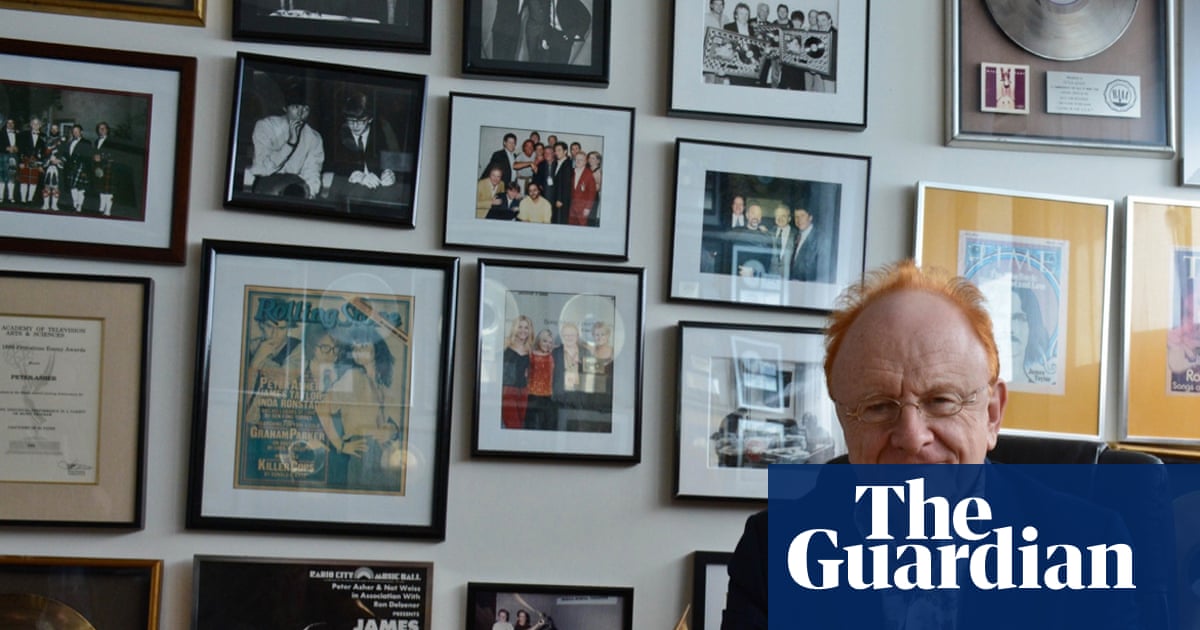
Peter Asher didn’t want to do this interview. He had the same reaction several years ago when directors Dayna Goldfine and Dan Geller approached him
Peter Asher didn’t want to do this interview. He had the same reaction several years ago when directors Dayna Goldfine and Dan Geller approached him about making a documentary about his life and career. “I don’t think so,” he recalled telling them in our interview, which wound up taking place only after several entreaties from the film’s publicist that he do this one sit-down. “My life has been startlingly devoid of the standard rock’n’roll drug-and-sex dramas,” Asher said. “So I thought a documentary about me isn’t something people will want to see. It sounds boring.”
On the contrary, Asher’s story stands among the most dramatic and consequential in music history, spurred by achievements that shifted the course of pop more than once. Through Asher’s pivotal role in the lives of stars like James Taylor and Carole King, he played a key role in instigating the gentle revolution that allowed singer-songwriters to dominate the charts in the 70s. He’s also partly responsible for the so-called “LA sound”, epitomized by the pristine albums he produced for stars like Taylor and Linda Ronstadt. At the same time, he raised the profile of the studio musicians he employed so dramatically, affecting how average listeners understood and appreciated the instruments they heard on the albums they loved. Small wonder the documentary on his life is titled Everywhere Man.
On a more gossipy level, Asher bears some credit, or blame, for two of the most storied relationships in rock’n’roll: the alliance of John Lennon and Yoko Ono, as well as that of Marianne Faithfull and Mick Jagger. And while it may be true that his own life is low on sex and drug escapades, he has proxy relationships to harrowing tales of heroin addiction, mental breakdowns and even suicide.
Not that Asher’s demeanor reveals any such tumult. Talking to him via Zoom from his home in Malibu, California, where he’s recuperating from a fall that shattered his leg, the 81-year-old producer exudes the caring air of a beloved professor. He speaks cleanly and engagingly, displaying an intelligence that has proven far more attractive to other musicians than any decadent shenanigans could have been. “I tend to think quite logically, with a degree of intellectual commitment,” Asher said. “And maybe that has helped.”
He came by that mindset genetically. His parents were respected intellectuals and creatives – his mother, an accomplished oboe player who taught at London’s Royal Academy of Music; his father, an endocrinologist who was the first person to identify Munchausen syndrome. It’s telling that Asher’s father didn’t name the syndrome after himself as most people in his position would have. “He was a man of remarkable character,” Asher said. “He thought it would be unreasonably egotistical to name a disease after yourself.”
Instead, he took the name from Baron Munchausen, a fictional 18th-century character whose lies reflected the psychology of the malevolent fantasists who exemplify the syndrome. Asher’s luck of birth extended to more than his fascinating parents. It accounts, too, for his flaming red hair, a trait shared by his two sisters, Clare and Jane. As children, they drew the attention of casting agents, leading to parts in films like The Planter’s Wife, in which Asher played the son of the Hollywood A-lister Claudette Colbert. “The fact that a real honest-to-God Hollywood star was playing my mother was incredibly exciting to me,” he said. “Even more so when I got to kiss her, which I did vigorously.”
Paul McCartney and Peter Asher Photograph: Greenwich Entertainment
Of the children, only Jane became a significant film actor, though it was her connection to a major pop star that affected Peter’s musical career. By the time they were teens, Jane was courted by Paul McCartney, who didn’t just fall for her beauty and charm but also for the intelligence of Peter and the erudition of their parents. “Paul was voraciously interested in music of all kinds, which included classical music,” Asher said. “My mother would say to him, ‘this is a clarinet, this is an oboe.’ That’s where he learned that a string quartet would be the right instrumentation for Yesterday.”
Jane’s connection to McCartney wasn’t the Asher family’s first link to the Beatles. When their producer, George Martin, was still a student at the Guildhall School of Music & Drama, he was required to take up a second instrument and he chose oboe. Wanting to learn from the best, he took private lessons with Asher’s mother in their home. McCartney had an equally homey connection to the family. When the Beatles began to become huge, McCartney sought refuge in the upper floor of the Asher home at 57 Wimpole Street. There, he wrote songs like Yesterday. “I imagine my mother would have been the first person to hear the song in its most primitive form,” Asher said.
Together, McCartney and Lennon wrote I Wanna Hold Your Hand in the family’s basement. But it was another song penned by McCartney that kickstarted Asher’s career. He’d formed a duo with his friend Gordon Waller based on the harmonies of the Everly Brothers, but they had no sturdy original songs. As luck would have it, McCartney had just written a sweet piece, A World Without Love, that John considered too treacly to record. Consequently, McCartney offered it to the duo, who were known as Peter and Gordon, and wonder of wonders, the result soared to No 1 in 1964 on both the UK and US charts. Spurred by that, Asher immediately quit school, a move that concerned his generally accepting parents. “I think they expected me to enter a respectable profession like being a doctor, rather than dropping out of university for absolutely no good reason except that I had a No 1 hit record,” Asher said. “I thought that was a very good reason.”
Gordon was considered the sexy one in the duo, Peter the “cute one”, based on his elfin features and shy demeanor. The horn-rimmed glasses and frilly outfits he sported led to later speculation that he was the physical, if not the characterological, inspiration for Mike Myers’ creation of Austin Powers, a reference he pleads ignorance to. Regardless, the role of pop star didn’t really interest him, which was one reason he soon hooked up with friends Barry Miles and John Dunbar to launch a bookstore and art gallery. They called them each Indica after the loopy strain of pot. The gallery made history as the place where John Lennon met Yoko Ono, who had a whimsical piece in the show that entranced the Beatle. Asher had an equally vital role in inaugurating Faithfull’s career. She was then married to Dunbar, and Asher invited them both to a party, where Faithfull met the Stones’ manager, Andrew Loog Oldham, who, besotted by her beauty, asked if she could sing. When she answered yes, he signed her. As invigorating as that was for Faithfull, it was less so for Dunbar. She promptly dumped him for Jagger.
Successful as Peter and Gordon were, their hits were penned by others and Asher longed to make music that no longer involved performing, so the duo soon ended. Though Asher had never produced an album before, the ex-Manfred Mann singer Paul Jones asked him on a hunch to oversee his debut solo album in 1966. The result was stellar and, though it didn’t hit, “it cemented in me the idea that I could, and should, be a record producer,” Asher said.
In the meantime, an offer he couldn’t pass up came from the Beatles to become A&R chief of their modern label, Apple. The roster he signed included artists as gifted as Billy Preston, Badfinger and, most invigorating to Asher, the Modern Jazz Quartet. The signing that changed his life, however, was a youthful American named James Taylor. “Every aspect of James thrilled me,” Asher said. “When I first asked him to play guitar I thought, ‘my God, here’s somebody who has the dexterity and stylistic elegance of a Julian Bream but with R&B changes.’ His voice managed to be really folky though he wasn’t singing folk music at all. Instead, he had this curious mix of the clarity of classical music with the harmonic element of jazz.”
James Taylor and Peter Asher in 1969. Photograph: Greenwich Entertainment
The self-titled album Asher produced for Taylor heaved with orchestrations, obscuring the singer’s intimate style. “This was my audition as a producer, so I thought I’d better do some damn producing,” he said. “I may have overdone it.”
It didn’t aid that Apple was disordered from the start, inspiring the ever-organized Asher to leave the company, taking Taylor with him. The move came at a dramatic time in his life. In 1969, his father killed himself, leaving the family shocked and distraught. He had lost his position at the hospital where he worked and fell into a depression, though Asher is loath to assign a specific reason for his father’s decision. “It would be facile, and I don’t think useful,” he said.
To aid cope, he concentrated on turning Taylor into a star. Moving to LA, he quickly secured him a deal with Warner Bros Records, then set about producing and managing him – no diminutive feats since Taylor was, by then, a major heroin addict. “I didn’t know much about junkies, but I did a bit of reading at the library to find out what I should do,” Asher said. “I said to James, ‘how can I help?’”
Luckily, Taylor’s “desire for heroin was equaled by his ambition and brilliance”, he said. “It’s a terrifying story but it does have a happy ending.”
Peter Asher. Photograph: Josh Kaplan
In fact, not only was Taylor’s Warner Bros debut, Sweet Baby James, a smash, it was the first of the singer-songwriter albums to break through, presaging a tsunami of commercial triumphs over the next year and a half for stars like Cat Stevens, Elton John and Joni Mitchell. Asher was instrumental, too, in King’s transition from peak songwriter to major performer. When he asked her to open for Taylor on tour in 1970, she had never before played a solo show. He also persuaded her to let Taylor record her song You’ve Got a Friend, which became a No 1 blockbuster. “That was contrary to the normal rules of show business where you don’t give away a hit,” Asher said. “It was so generous of her.”
Asher was equally generous to the studio musicians who performed on the albums he oversaw, awarding prominent credit on the album sleeves to players such as guitarist Danny Kortchmar and bassist Lee Sklar. It was a largesse that session instrumentalists had never received before. “At the time, I didn’t realize that was such a radical change,” Asher said. “Before that, the photographer who took the album’s cover shot was more prominently displayed than the people who played on the record. I thought that was ridiculous.”
The enhanced crediting didn’t just make musicians like drummer Russ Kunkel stars, it schooled average listeners on the importance each instrument played in the mix, allowing them to better appreciate a recording’s construction and nuances. Asher used many of those same players on the smash albums he produced for Ronstadt, who he also managed. Before Asher worked with her, Ronstadt had recorded four albums that failed. He shaped her sound while also listening to her instincts like no producer had before. “Prior to that, she was confronted with a lot of ‘don’t worry your pretty little head about that’ stuff,” he said. “People thought you couldn’t be that good a singer and that beautiful and smart and well-read as she was. That did not compute in that era.”
The sound Asher got for Ronstadt and others had a precision that epitomized the LA sound, which drew some criticism. “They said, ‘too clean’,” Asher said. “I’m guilty of that, I guess. I do get hyper-hygienic when deciding if there’s extraneous notes or chords. I’m not very fond of muddle.”
The result yielded a mountain of hit albums and won Asher the producer of the year Grammy twice. In the years since, he has overseen albums by everyone from Cher to Diana Ross to Randy Newman. His most recent production was for Barbra Streisand’s 2025 duets album, where he paired her with the Icelandic singer Laufey, whom he adores. He’s equally besotted with youthful artists like Raye and Rosalía. Yet, as he approaches his 82nd birthday this month, Asher remains modest about his achievements. When I asked him what it took to enjoy a career as impressive as his, he answered quickly. “The secret is simple” he said, “work with incredibly talented people.”


COMMENTS