
The US will look to augment the number of international co-productions that shoot in the country once its federal tax credit is up and running,
The US will look to augment the number of international co-productions that shoot in the country once its federal tax credit is up and running, according to Steven Paul, producer and special advisor to US ambassador to Hollywood Jon Voight.
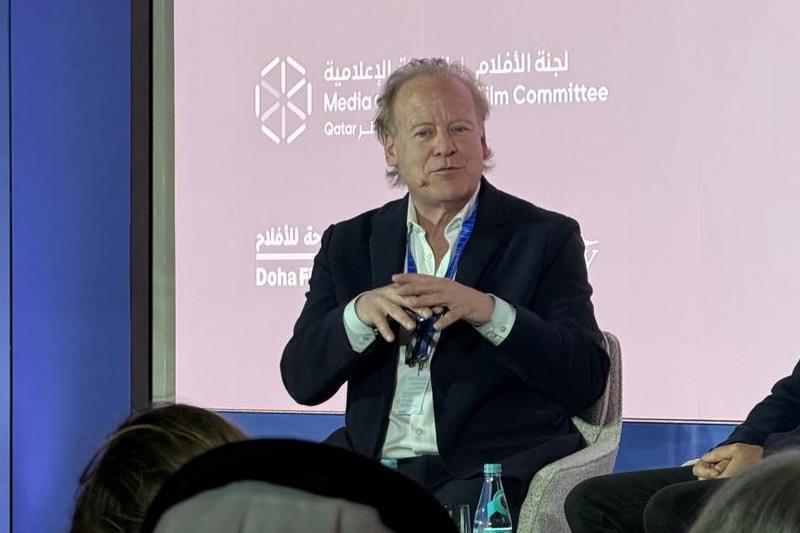
“Right now there are no co-productions, and there was nobody really discussing co-productions except me, in my mind,” said Paul in a Fireside Chat at Doha Film Festival’s Doha Industry Days. “That’s the next thing I would want to be pushing after [the tax credit] takes place, to get co-productions. That way, it’s reciprocal all around the world; we can go here or there, all of us are working together, a united film business.”
The Doha Industry Days is organised by the Film Committee at Media City Qatar, of which 2022 Fifa World Cup organiser Hassan Al Thawadi is chairman. Al Thawadi is eager for the Middle East nation to be the first country to work with the US post-tax credit, said Paul. “Hassan was saying ‘I’ve got to be number one’ – I agree,” said Paul. “First co-production, with Hassan, here in Qatar.”
The producer still hopes the tax credit will be up and running in January 2027, with legislative steps to pass first. “We still have a little way to go. There’s some legislation written. It has to be attached to some sort of bill,” said Paul. “This is stuff I’ve never been involved in. We’re hoping it gets attached to a bill in the upcoming weeks and gets voted on before the end of the year, so it will be active starting in January.”
“We put together a huge coalition to do it. Right now, there are 90 to 100 senators and congresspeople who have already come on, both Democrats and Republicans. The vote hasn’t even taken place; [that’s] just to co-sponsor and put your name to it.”
Paul said that the federal credit combined with state tax credits could allow productions to access over 50% in tax credits. “The federal credit is between 20 and 30%. It starts at 20%, then there are two uplifts. If you’re independent, you get 5% more, and if you’re filming in what is considered a disaster area, you get another 5%, which goes on top of the state tax credit.”
“You can get both of them. You get 20 to 30% state tax credit, and potentially another 20 to 30% on the federal.”
Responding to a question from Olsberg SPI’s Jonathan Olsberg about whether the credit could lead to states adjusting their state tax credits and have an “inflationary impact” on production costs, especially in high production areas such as New York, Paul responded, “I think production will increase in all of those places.”
“You’ll have state tax credit, which is already there, and the federal tax credit on top of it. And you’ll have states where there is no state tax credit; people will go to film for the first time, and that’s great for the communities. There are places we should be filming because it’s organic to a movie.”
“I don’t believe they’ll reduce it,” said Paul in response to the possibility that individual states may drop their own credits. “I think they’ll still want to outbid each other
Paul said that the idea of tariffs on international films coming into the US is no longer under discussion. “Thankfully I haven’t heard the word tariff in a while,” said the producer. “In the beginning, we were hearing tariffs all the time. But no, now it’s all hands on deck [on the] federal tax credit.”
Doha Film Festival runs until Friday, November 27.

