
It’s been more than 55 years since reporter Seymour Hersh published the story that would shock the country and the world: an account of how a U.S.
It’s been more than 55 years since reporter Seymour Hersh published the story that would shock the country and the world: an account of how a U.S. Army platoon under the command of Lt. William Calley slaughtered hundreds of innocent Vietnamese men, women and children during the Vietnam War. The incident would come to be known as the My Lai Massacre.
If that had been the only crucial story Hersh ever broke, it would have sealed his reputation as one of the most significant investigative journalists of this or any time. Yet Hersh followed My Lai with other stunning exposés: on the U.S. secret bombing of Cambodia, Watergate, the CIA’s domestic spying program, on the Abu Ghraib scandal during the Iraq War, and a story of great interest to those in Hollywood — financial misdeeds in the 1970s by Gulf+Western, then-parent company of Paramount Pictures.
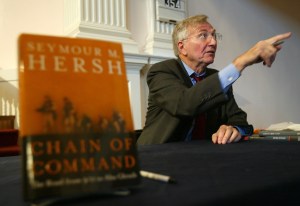
Investigative journalist and author Seymour Hersh at a book signing for his nonfiction work ‘Chain of Command: The Road from 9/11 to Abu Ghraib’ on September 19, 2004 in Washington, DC.
Alex Wong/Getty Images
Hersh’s unparalleled career is explored in the documentary Cover-Up, directed by Oscar winner Laura Poitras and Mark Obenhaus, which screens tonight at the New York Film Festival. Poitras, Obenhaus and fellow producers Olivia Streisand and Yoni Golijov are expected to join Hersh along with one of the journalist’s key Abu Ghraib sources — Camille Lo Sapio — for a panel discussion after the screening. Netflix acquired the documentary after its world premiere at the Venice Film Festival.
“In many instances, of course he is driven by moral outrage,” Obenhaus tells Deadline regarding what drives Hersh. “I think it’s certainly expressed in the film his strong feelings about My Lai, Abu Ghraib, other events. But I don’t think it is of such a nature that it colors his search for the facts.”

Investigative journalist Seymour Hersh in ‘Cover-Up’
Netflix
The search for facts about Hersh leads the filmmakers to Chicago, where Hersh, 88, was born in April 1937, the son of a man who owned a South Side desiccated cleaners. Eventually, his father would ask Sy to run the business – not because he was an accounting whiz, for instance, but for his capacity to schmooze with customers. The gift of gab would serve him well in his journalistic career.
“He’s known as being a great talker, he’s a great gossip. I think people like to spend time with Hersh,” Poitras notes. “I think we had a good time, we had some hard times, but in general it’s been a complete delight to be in his orbit… He’s incredibly brilliant and charming.”
“[Sources] speak to Sy for many reasons,” adds Obenhaus. “Some because they’re deeply troubled by an issue that perhaps their agency — in the case of the CIA — is pursuing that they object to. But there’s also people who have grievances… I can think of some examples of this that are a completely different political persuasion than Sy. I think they see him as a viable messenger for conveying information and in many cases, situations where they’re troubled by something that their government is involved in.”
As Hersh puts it in the film, “I give service to good leaks.”
An Iraqi detainee at Abu Ghraib Prison is menaced by a dog under the control of a U.S. soldier (undated photo).
Washington Post via Getty Images)
In 2004, the journalist got his hands on a secret U.S. military report investigating allegations of outrages committed by American personnel on Iraqi detainees held at Abu Ghraib, a U.S.-run prison just outside Baghdad. His New Yorker piece, quoting the report, catalogued the abuses: “Breaking chemical lights and pouring the phosphoric liquid on detainees; pouring cold water on naked detainees; beating detainees with a broom handle and a chair; threatening male detainees with rape… sodomizing a detainee with a chemical light and perhaps a broom stick…”
Eleven soldiers were court-martialed and convicted for their actions at Abu Ghraib, but higher-ranking officers escaped charge. It was a similar scenario in Vietnam, where the top brass didn’t take the fall for My Lai.
“I think his deep skepticism of the higher ranks of the military and their ability to escape responsibility for actions of soldiers is I think something that troubles him to this day,” Obenhaus observes. “Certainly, through Abu Ghraib, but My Lai [too]. I think we make that clear in the film.”
(L-R) Seymour Hersh, directors Laura Poitras and Mark Obenhaus attend the ‘Cover-Up’ photocall during the Venice Film Festival on August 29, 2025.
Theo Wargo/Getty Images
For someone who has asked countless questions of countless people, Hersh proved less than eager to entertain personal inquiries.
“I was very happy not talking about myself,” he informs Poitras and Obenhaus at one point. “Very happy.”
At one stage he almost bailed on the whole documentary enterprise but later returned to the interview room to resume questioning.
“I think Laura was marvelous and instrumental [so] we could kind of tag team and get to him,” Obenhaus says with a hint of amusement. “I think he went into it kicking and screaming, but he was aware that he had to go somewhere that he hadn’t gone before. And I think that you’ll see in numerous instances with Laura’s questions about his personal life he resists, but he does it. And I think he knew going into this project that if this was going to be the film that we all thought it should be, there had to be more about his personal life.”
Seymour Hersh and his wife Elizabeth Klein attend the premiere of ‘Cover-Up’ at the Toronto International Film Festival on September 10, 2025.
Dominik Magdziak/Getty Images
Under gentle prodding from the directors, Hersh offers a modicum of words about his long-term union with Elizabeth Klein, a psychoanalyst to whom he has been married for more than 60 years. Mostly, he keeps a lid on his private life.
“He’s been very protective and boundaried about his family in ways that I have a lot of respect for,” notes Poitras. “I am very critical of this documentary genre where you have sort of ‘thin access.’ You may see a family scene, but nothing will happen, and you feel like you’ve actually learned nothing. So, I actually think it’s good that the film is holding back some details. And the film is really about Sy Hersh and his body of work.”
It’s work that continues even as the restless Hersh approaches 90. He’s seen in the film working Palestinian sources for inside information on the destruction of Gaza, as energetic and driven as ever.
“Obviously, I think that someone like Sy is essential to a flourishing democracy. However, I think that the kind of work that he’s done historically is perhaps more difficult or it is not rewarded or trusted in the way it once was,” Obenhaus comments. “The role of a reporter like Sy I think has a big question mark over it now — what kind of impact could a young Sy Hersh now have? …Sy rose at a time when there were three television networks; two, maybe a couple more papers of relevance, of importance… Things that were published there had a resonance that is just far greater than the reporting of reporters who might emulate Sy in this day and age.”
The film acknowledges criticism of Hersh from some who say he’s too cloudy about his sources. And it alludes to a time that he was almost snookered into publishing purported letters between President Kennedy and his mistress Marilyn Monroe – missives that turned out to be forged. But there’s no question where the directors stand on Hersh’s importance.
“The magnitude of Sy’s work is just so astounding that what this man has uncovered, it just should be celebrated in every newsroom, every journalism school,” Poitras insists. “It’s a staggering body of work that he’s produced in his lifetime… So yeah, okay, maybe Sy didn’t get every story right, but what are we talking about? A country that is torturing and murdering people and massacring them. I think that’s where the outrage should be. I want to sort of flip where the outrage should be, which is on governments that lie, that commit crimes and that allow people who orchestrated these crimes to walk away. For me, that’s what I hope is the moral outrage of the film.”


COMMENTS