

By Nabil Alani - CIFF46 In Complaint No. 713317, Egyptian filmmaker Yasser Shafiey proves that great cinema does not require grand locations, sweepin
By Nabil Alani – CIFF46
In Complaint No. 713317, Egyptian filmmaker Yasser Shafiey proves that great cinema does not require grand locations, sweeping narratives, or a large cast. Sometimes, the most profound stories erupt from the smallest domestic accidents. In his feature debut—premiering in the Horizons of Arab Cinema competition at the 46th Cairo International Film Festival—Shafiey transforms a malfunctioning refrigerator into a surprisingly rich metaphor for marriage, class struggle, and the labyrinth of modern bureaucracy.

The couple faces the faulty fridge that becomes the catalyst for their spiraling conflict.
Set almost entirely within a modest Maadi apartment, the film follows Magdy and Sama, a retired couple whose lives unfold at the quiet pace of routine. Their home, with its muted walls and relics of past decades, becomes both a sanctuary and a cage. The day Magdy accidentally punctures the family fridge marks the beginning of a slow, darkly comic unraveling—not only of the appliance, but of emotional fissures the couple has avoided for years.

The film’s team celebrates their premiere on the CIFF46 red carpet.
Mahmoud Hemida, in one of his sharpest performances, plays Magdy as a man caught between wounded pride and material helplessness. His refusal to buy a new fridge—despite his wife’s recent retirement bonus—signals far more than thrift. Hemida captures the psychology of an aging patriarch clinging to outdated notions of authority, even as his life quietly collapses around him. Opposite him, Shereen delivers a beautifully restrained portrayal of Sama—a woman fighting to maintain dignity, order, and tenderness in a marriage worn thin by habit. Their chemistry brims with nostalgia, resentment, and the unmistakable tenderness of a long, complicated life together.
What begins as a small inconvenience spirals into a surreal odyssey when the couple contacts a repair company. Here, the film slips into a beautifully crafted theatre of absurdity. The technician—played with impeccable comic timing by Mohamed Radwan—spins outrageous tales of engineering brilliance, foreign marriages, NATO missions, and heroic submarine adventures. His unreliable assurances echo a familiar Egyptian rhythm: the blend of charm, improvisation, exaggeration, and avoidance that pervades daily service interactions.
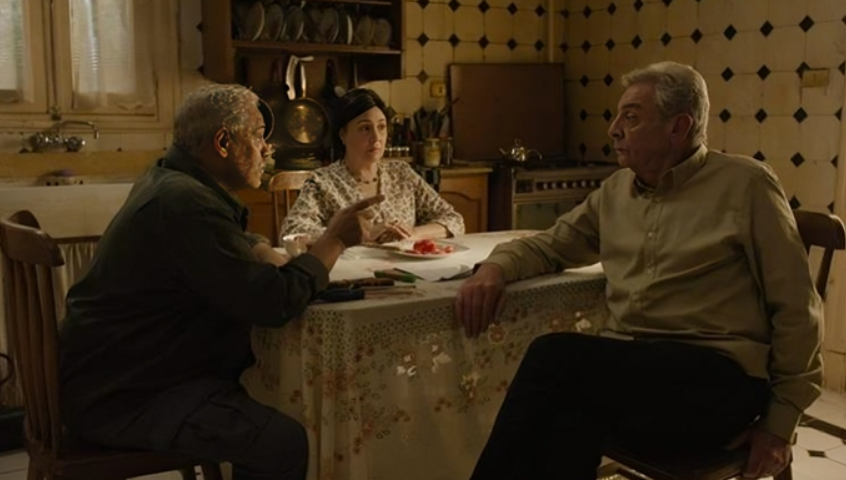
A tense kitchen exchange as the broken fridge begins to unravel deeper marital cracks.
Meanwhile, Enam Salousa appears in just a handful of scenes, yet her performance as the evasive repair-shop owner adds a layer of deadpan brilliance. Her presence distills the essence of institutional apathy: confident, courteous, and utterly useless. Through her character, Shafiey subtly critiques a system in which every “service provider” is an actor in a long-running tragicomedy of delay and deflection.
Visually, the film embraces stillness. Cinematographer Karim Fouad Hakim composes frames that feel almost theatrical—static, meticulous, quietly suffocating. This stability amplifies the emotional tension, as if the apartment itself were watching the couple unravel. Small details—plastic vegetable-shaped fridge magnets, a dusty desktop computer, faded armchairs—build an authentic portrait of a middle-class home suspended between nostalgia and stagnation.
Shafiey, who previously directed acclaimed shorts such as The Dream of a Scene and The Man Who Swallowed the Radio, strengthens the film’s tone with a structure that echoes Kafka and Riffat Al-Meehy: bureaucratic absurdity sharpened by sincere human observation. The pacing is deliberate, allowing frustration to ferment slowly, echoing the lived reality of citizens who spend months chasing basic rights. When Magdy files the official complaint—number 713317—the film shifts into deeper commentary, exposing how institutions drain time, dignity, and even affection from those trapped within them.

Magdy and Sama share a tender, nostalgic dance amid rising emotional distance.
Yet Complaint No. 713317 is not merely a social critique. It is also a penetrating study of marriage. As days turn to months and the fridge remains unfixed, unresolved resentments surface: financial inequality, gender roles, emotional fatigue, and the quiet ache of a grown son who never visits. Hemida and Shereen anchor the film in emotional realism, portraying a couple who cannot articulate their pain except through arguments about appliances, money, or misplaced pride.

The cast and crew of Complaint No. 713317 on stage at the CIFF46
The production design—crafted with remarkable sensitivity—deepens this emotional portrait. The apartment appears lived-in rather than staged; every object speaks of years of deferred dreams and careful saving. These choices evoke a generational condition: couples who built their lives within fixed social and economic boundaries, now forced to confront a world where even the simplest repairs demand energy they no longer have.
In its final act, the film transcends all expectations. What could have been a typical comedic climax instead becomes a quiet reclamation of agency, a symbolic release from humiliation. Without spoiling the moment, it is enough to say that Shafiey delivers a conclusion that is not loud, but liberating—one that transforms a domestic malfunction into a poetic statement on dignity.

Official poster for Complaint No. 713317, competing in CIFF’s Horizons of Arab Cinema.
Its craft, nuance, and thematic coherence make it one of the most distinct cinematic voices to rise from Egypt’s new wave.”. It is a debut that balances humor with melancholy, social critique with intimate character study, and realism with controlled absurdity. Shafiey crafts a world where a fridge is never just a fridge—it is a battleground of pride, exhaustion, gender dynamics, and the eternal struggle to remain human within an indifferent system.
At CIFF 46, this film distinguishes itself not through spectacle but through clarity, courage, and a deep understanding of how cinema can elevate the everyday into something quietly magnificent.


COMMENTS