
While the country club’s GM, Joshua Martín (Oscar Isaac, coiffed in a surprisingly inoffensive mullet), and his interior-decorator wife, Lindsay Cran
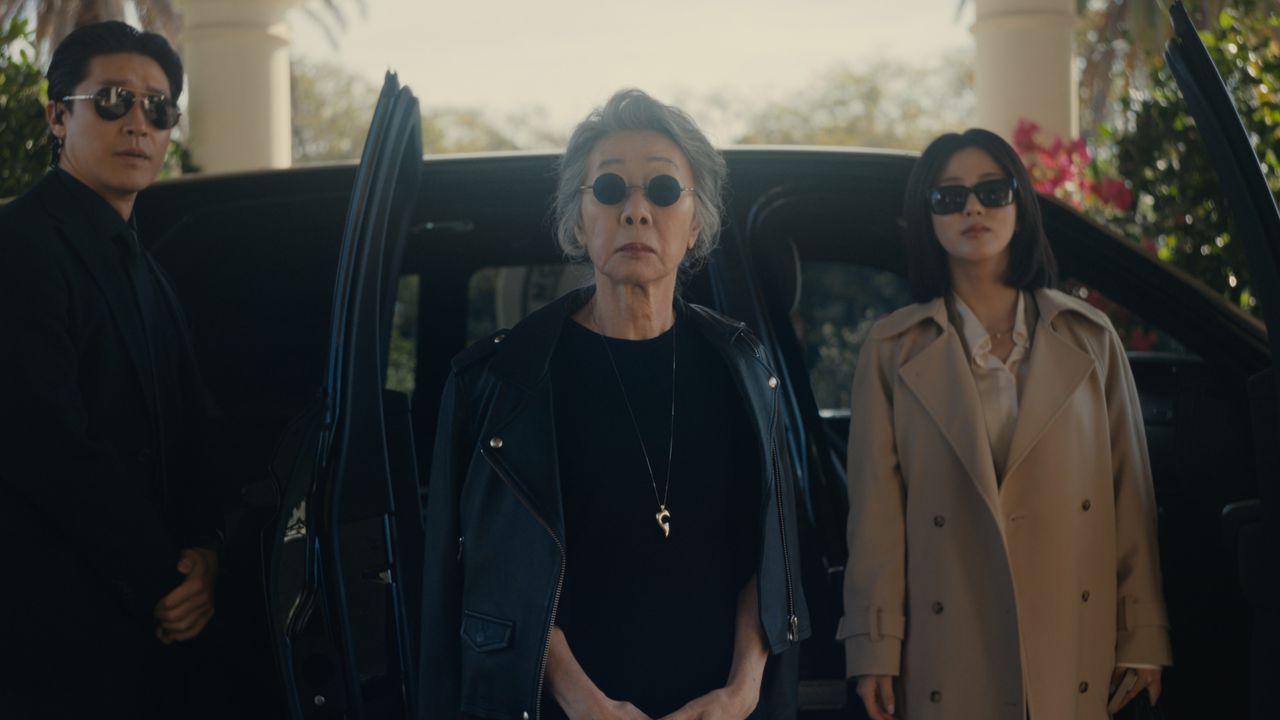
While the country club’s GM, Joshua Martín (Oscar Isaac, coiffed in a surprisingly inoffensive mullet), and his interior-decorator wife, Lindsay Crane-Martín (a quietly brilliant Carey Mulligan), have respect for chairwoman Park’s extreme wealth, the cultural nuances of her position are lost on them. When Lindsay shows the chairwoman a room at the club that she’s just decorated, interpreter Eunice (Seoyeon Jang) tells her that the chairwoman finds the design “very colonial.” Lindsay reverently bows and replies, “Thank you so much,” only for Eunice to clarify: “She does not like colonial.” What Lindsay doesn’t understand is that many Koreans of chairwoman Park’s generation have long-standing beef with Japan—the nation that occupied Korea under colonial rule from 1910 to 1945.
The chairwoman’s money and prestige stem from that break with colonization, and also operate under its shadow. The show doesn’t spell this out, though, leaving it in the realm of if you know, you know—displaying the same culturally specific confidence it did in season one.
That said, if you do want a primer on how the real Korean billionaire class came to be über powerful and how that power structure low-key permeates Beef’s second season, read ahead.
What Is a Chaebol?
South Korea is often upheld as a infrequent example of how a country can go from extreme poverty to a developed economy—it now has one of the world’s 15 largest GDPs—in a single generation. Korea was primarily agricultural until the mid-20th century, growing mostly rice; now, the nation’s top global export is K-pop stars. (Fact-check: It’s actually semiconductors.)
This swift rise began after the Korean War. By 1953, the country’s industrial facilities had mostly been reduced to rubble; the economy was paralyzed, making South Korea one of the poorest countries worldwide, according to “The Origins of Korean Chaebols and Their Roots in the Korean War,” by Rhyu Sang-young. The government chose select families to purchase ex-Japanese colonial-era assets at rock-bottom prices. These family-led companies received tax breaks and favorable loans from the government, which aided their rapid expansion into international trade and manufacturing, all while bringing South Korea out of poverty. A win-win!
Except, of course, the truth is more complicated. As explained in “The Politics of Growth in South Korea,” Chaebol families helped modernize the country while forming cozy relationships with military dictator Park Chung-hee—who seized power in 1961, brought banks under state control to benefit the chaebol system, and ran the country until he was assassinated by his friend in 1979. Park’s legacy, like the chaebol families he supported, is a divisive one: He’s considered South Korea’s most influential 20th-century leader, though his authoritarian regime also suppressed democracy and incited political violence for the sake of economic development.
A chaebol—a portmanteau of the words for “wealth” and “clan”—has nepotism built into its very structure. Companies stay within the same family for generations, and chaebol families will “do everything to have succession possible,” says Park Sang-in, a professor at the School of Public Administration from Seoul National University. The largest chaebol is Samsung, which started as a grocery trading store. Talk about a pivot!
The company’s current chairman is Lee Jae-yong: grandson of Samsung’s founder and South Korea’s richest person, with a net worth of currently $26 billion. In 2017, Lee was convicted of bribing then-president Park Geun-hye with almost $8 million to gain her support for a merger. He was sentenced to two and a half years in prison, but only served 18 months after being released on parole and later receiving a presidential pardon. Last year, he was cleared of fraud charges regarding a separate merger. His tardy father, Lee Kun-hee, was convicted of bribery twice, but never went to jail, also thanks to presidential pardons. For some in South Korea, the long history of chaebol corruption and their pardons are a sign that the chaebol families wield too much power and can’t be held accountable. Professor Park says that for the chaebol families, “the most important privilege is that you will not go to jail if you commit any crime.”


COMMENTS