

Venice 2025 | TheWorldScreen Review By Sari Albeder | TheWorldScreen VENICE, Italy — Sometimes history returns at precisely the moment audiences are
Venice 2025 | TheWorldScreen Review
By Sari Albeder | TheWorldScreen
VENICE, Italy — Sometimes history returns at precisely the moment audiences are ready to see it through a different lens. Nearly five decades after a shocking hostage crisis unfolded in downtown Indianapolis, director Gus Van Sant revisits the extraordinary true story in Dead Man’s Wire, a gripping psychological thriller that premiered Out of Competition at the 82nd Venice International Film Festival.
While the film recreates events from 1977, its themes—economic frustration, corporate power, public distrust, and the growing divide between ordinary citizens and powerful institutions—feel strikingly contemporary. Without drawing direct comparisons to modern headlines, Van Sant explores the emotions that can emerge when desperation collides with perceived injustice, creating a film that resonates far beyond its historical setting.
More than a hostage drama, Dead Man’s Wire is a study of how personal grievances can evolve into public spectacle, and how the media, law enforcement, and society respond when an ordinary individual decides to force the world to listen.
A Forgotten True Story Returns to the Spotlight
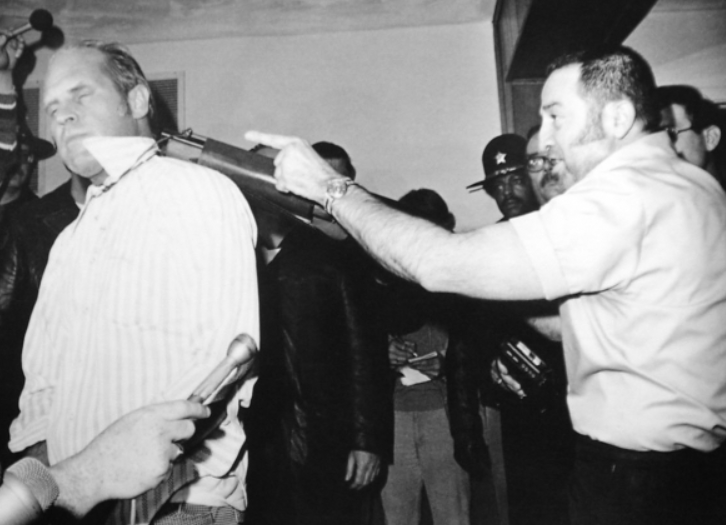
On February 8, 1977, Indianapolis businessman Tony Kiritsis entered a mortgage company carrying a shotgun attached to a deadly trigger mechanism. Within minutes, he had taken executive Richard Hall hostage, demanding millions of dollars, legal immunity, and a public apology from the company he believed had ruined his life.
The incident quickly escalated into one of America’s most unusual hostage crises, unfolding live before television cameras and captivating audiences across the country.
Rather than sensationalizing the violence, Dead Man’s Wire examines the psychology behind the confrontation. The film asks difficult questions about frustration, justice, and the fragile relationship between institutions and the individuals who feel abandoned by them.
Gus Van Sant Returns to Venice with Quiet Confidence
More than three decades after first appearing at the Venice Film Festival, Gus Van Sant returns with a film that feels both intimate and politically aware.
Known for balancing independent storytelling with mainstream accessibility in films such as Good Will Hunting, Milk, My Own Private Idaho, and Elephant, Van Sant once again demonstrates his ability to find humanity within extraordinary circumstances.
His direction remains remarkably restrained.
Rather than relying on explosive action or exaggerated suspense, he builds tension through conversation, silence, and the growing emotional pressure inside increasingly confined spaces.
Every scene unfolds with measured precision, allowing the audience to experience the uncertainty alongside both hostage and captor.
Bill Skarsgård Delivers One of His Strongest Performances
Bill Skarsgård steps away from many of the darker genre roles that have defined parts of his recent career to portray Tony Kiritsis with remarkable complexity.
His performance never attempts to excuse the character’s actions, nor does it reduce him to a one-dimensional villain.
Instead, Skarsgård presents a man consumed by frustration, convinced he has exhausted every legitimate path available to him. His growing desperation becomes increasingly uncomfortable to watch precisely because the film refuses simple moral judgments.
It is a performance built on emotional instability rather than theatrical intensity.
Every conversation feels unpredictable.
Every decision appears capable of changing the outcome.
The result is one of Skarsgård’s most compelling dramatic performances to date.
Dacre Montgomery Brings Humanity to the Hostage
Opposite Skarsgård, Dacre Montgomery delivers an understated yet emotionally powerful performance as Richard Hall.
Trapped for hours with a loaded shotgun literally attached to his neck, Hall becomes more than a victim.
Montgomery gradually reveals a man balancing fear, survival, and emotional exhaustion while navigating increasingly complex negotiations.
The quiet chemistry between Montgomery and Skarsgård becomes the emotional engine driving the film.
Much of the suspense comes not from physical violence but from psychological interaction.
Al Pacino Makes Every Scene Count
Although his screen time is limited, Al Pacino brings considerable authority to the role of M.L. Hall, the businessman whose decisions influence the unfolding crisis.
Pacino avoids dramatic excess, portraying a corporate leader whose confidence and refusal to compromise become central to the escalating tension.
His presence adds additional weight to the conflict without ever overshadowing the central narrative.
A Strong Supporting Ensemble
The supporting cast provides depth to every aspect of the unfolding drama.
Colman Domingo delivers another characteristically assured performance, bringing calm professionalism to a situation rapidly spiraling beyond anyone’s control.
Myha’la shines as an ambitious television reporter whose determination to cover the story reflects another important dimension of the crisis—the growing influence of live media coverage.
Together, the ensemble creates a believable portrait of a community suddenly thrust into national attention.
The Media as a Character
One of the film’s most fascinating aspects is its examination of television journalism during the late 1970s.
As cameras gather around the unfolding hostage situation, Van Sant explores how media attention transforms private tragedy into public spectacle.
Reporters compete for exclusive coverage.
Viewers become emotionally invested.
Negotiators find themselves operating beneath constant public scrutiny.
The film never condemns journalism outright but instead illustrates the complicated relationship between news coverage and real-world events—a subject that remains just as relevant in today’s era of continuous digital media.
Tension Built Through Simplicity
Rather than constructing elaborate action sequences, Van Sant focuses almost entirely on atmosphere.
Offices, apartments, police barricades, and television crews become the film’s primary locations.
The confined settings amplify emotional pressure, creating suspense through dialogue, body language, and uncertainty rather than spectacle.
Austin Kolodney’s screenplay keeps the narrative tightly focused, allowing character dynamics to drive the story instead of unnecessary embellishment.
The result is a thriller that feels grounded in reality while maintaining remarkable dramatic momentum.
Venice Film Festival 2025
More Than a Crime Story
Although Dead Man’s Wire recreates an extraordinary hostage crisis, its deeper concerns lie elsewhere.
The film examines what happens when individuals lose faith in systems designed to protect them.
Questions surrounding financial hardship, institutional power, personal accountability, and public perception remain at the heart of the narrative.
Without becoming overtly political, Van Sant invites audiences to consider why some people reach breaking points—and how society chooses to respond when they do.
These themes give the film significance far beyond its historical setting.
Technical Craftsmanship
Visually, the film embraces a restrained aesthetic that reflects the grounded realism of the story.
The cinematography avoids unnecessary stylization, instead emphasizing naturalistic compositions that immerse viewers in the unfolding events.
Editing maintains consistent tension throughout the runtime, while the production design effectively recreates late-1970s America without allowing nostalgia to overshadow the drama.
Every technical element serves the story rather than calling attention to itself.
Venice Reception
Premiering Out of Competition at Venice, Dead Man’s Wire generated considerable interest among festival audiences eager to see Gus Van Sant’s return to feature filmmaking.
The film was praised for its strong performances, measured direction, and thoughtful approach to true-crime storytelling.
Its timely exploration of public anger, corporate power, and media influence also sparked discussion among critics following the screening.
Whether viewed as a historical drama or a contemporary reflection on social frustration, the film clearly struck a chord with festival audiences.
TheWorldScreen
With Dead Man’s Wire, Gus Van Sant demonstrates once again why he remains one of American cinema’s most thoughtful storytellers.
Rather than sensationalizing violence, he constructs an intelligent psychological thriller driven by exceptional performances, careful direction, and enduring social relevance.
Bill Skarsgård delivers a career-highlight performance, supported by an accomplished ensemble that includes Dacre Montgomery, Colman Domingo, Myha’la, and Al Pacino.
What begins as a true-crime reconstruction gradually evolves into something much larger—a reflection on desperation, justice, media influence, and the consequences of a society increasingly divided by economic and institutional distrust.
It is a film that refuses easy answers while reminding audiences that history often echoes far beyond the era in which it unfolds.
TheWorldScreen Rating
★★★★☆ (4/5)
Film Information
Title: Dead Man’s Wire
Director: Gus Van Sant
Writer: Austin Kolodney
Cast: Bill Skarsgård, Dacre Montgomery, Colman Domingo, Myha’la, Cary Elwes, Kelly Lynch, Al Pacino
Running Time: 104 minutes
Section: Out of Competition – Venice International Film Festival 2025
Genre: True Crime • Drama • Thriller
Sales: WME

