
Doha Film Festival (DFF) opened with a defiant spirit despite the ongoing Iran-US war, with festival director Fatma Hassan Alremaihi saying “we
Doha Film Festival (DFF) opened with a defiant spirit despite the ongoing Iran-US war, with festival director Fatma Hassan Alremaihi saying “we could have cancelled, but we did not.”
“Even in the most difficult of times, the Doha Film Institute [DFI, which organises the festival] has continued to stand alongside filmmakers and support independent cinema,” said Alremaihi. “We have had a difficult year, but we have not ceased to achieve.”
Alremaihi, who is also DFI CEO, cited the Institute supporting more than 100 projects from 56 countries this year, and backing more than 50 films which have played at international festivals.
“When circumstances became more severe, challenges intensified, and the odds seemed stacked against us, we could have postponed, scaled back, waited or cancelled. But we did not,” said Alremaihi. She noted that, although the Qumra project incubator had to withdraw its March in-person edition due to the recent war, it quickly reconfigured as a digital event. “It continued to support 49 projects from 39 countries.” The director also cited the opening of the first cinema at Doha’s Hamad International Airport, one of the world’s major transit airports.
“We achieved a lot this year, and proved again that culture, arts and films are not closed silos,” said Alremaihi. “They are a living, breathing space.”
Encouragement
Alremaihi then presented two honorary Creative Excellence Awards to Indian actor-filmmaker Nandita Das and Syrian actor Taim Hassan. “During the past 25 years, I had quite a few roles in cinema,” said Hassan, who has credits including 2022’s Al Hayba and 2015’s Plan B. “I hope to have the chance in the next 25 years to increase my role in cinema.”
“Independent cinema is not easy to make these days,” said Das, who has directed features including 2018’s Manto and 2022’s Zwigato. “A lot of freedom of expression is being challenged. So when you get this encouragement, this pat on the back, it really feels like you have to keep going.”
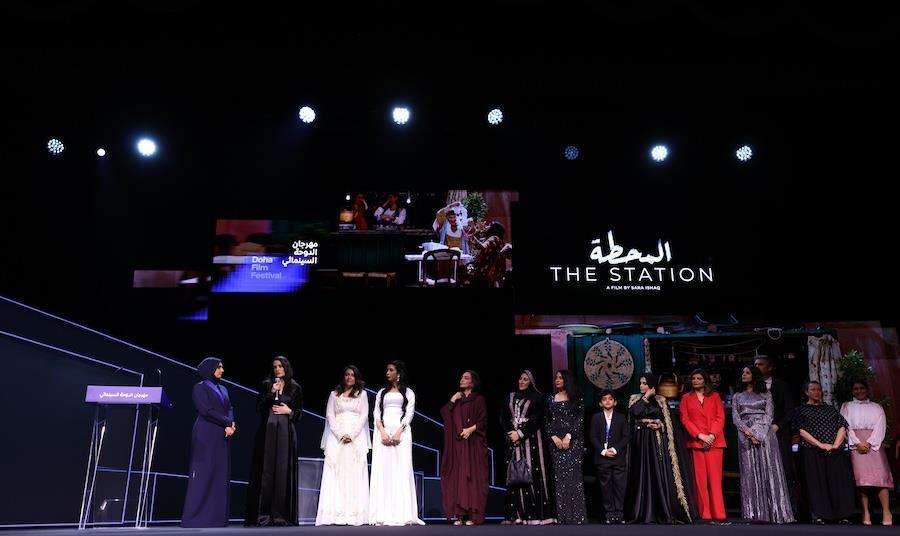
The festival opened with the MENA premiere of Sara Ishaq’s The Station, about a women-only petrol station in Yemen which is a sanctuary during the country’s civil war. “Making films, watching films, can sometimes feel very trivial,” said Ishaq. “If there’s something this film taught me, it’s that the work that we do isn’t trivial. It brings humanity to the headlines.”
“Perhaps films do not stop wars and genocide, but it is our means as filmmakers to prove and to impose our narratives in the hope that this world becomes more open,” said producer and co-writer Nadia Eliewat. “With every story we tell, every cause on which we show light, every dream we dream.”
The pre-film ceremony finished with a musical performance by Fatima Muthanna, who also appears in The Station.
DFF runs until Friday, November 27, and will award over $300,000 in prizes across its four competition sections: International Feature Film, International Short Film, Made in Qatar and Ajyal.

