
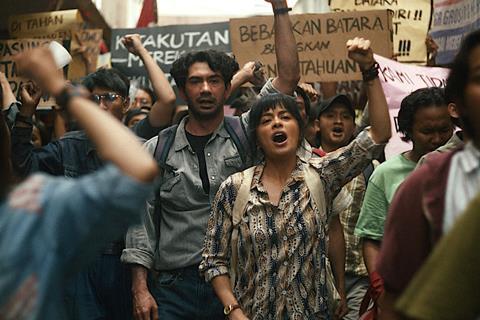
Dir: Yosep Anggi Noen. Indonesia. 2026. 133mins Dictatorial rule, oppression and the power of grassroots rebellion lay the foundations for Yosep
Dir: Yosep Anggi Noen. Indonesia. 2026. 133mins
Dictatorial rule, oppression and the power of grassroots rebellion lay the foundations for Yosep Anggi Noen’s The Sea Speaks His Name. Unfolding in the early 90s, at the beginning of the collapse of Indonesia’s three-decade Suharto regime, the film reunites the director with his 24 Hours With Gaspar star Reza Rahadian, who plays a university student driven to political activism. Noen’s mix of history and mystery makes for a timely drama that speaks to our collective moment as well as to Indonesia specifically.
Speaks to our collective moment as well as to Indonesia specifically
Based on Leila S Chudori’s 2017 novel, The Sea Speaks His Name explores the same subject matter as Noen’s Solo Solitude (2017), which had a well festival run, and could well follow that same trajectory. The film’s vague political thriller vibes put it in the same company as Kleber Mendonça Filho’s Oscar nominee The Secret Agent, and Noen pulls more than a few pages from Luis Puenzo’s The Official Story, The Secret in Their Eyes by Juan José Campanella, and even Walter Salles’s I’m Still Here. That, together with the film’s classic, accessible structure, could see it chime with audiences who responded to those politically-minded dramas.
The Sea opens with a haunted monologue by a one-time political prisoner spoken over the deceitfully soothing waves of the waters that surround Indonesia, – seas that we learn may have drowned some ugly truths during the preceding years. Somewhere in Jakarta one evening in March 1998, just weeks before the resignation of dictator Suharto, former activist Biru Laut (Rahadian, an executive producer here and director in his own right with 2025’s On Your Lap) is making dinner when a trio of unidentified government thugs break in and promptly disappear him from his flat. It’s a classic bit of political thriller film craft, with the eerily still apartment block’s hallways shrouded in shadow and nervous neighbours pulling back curtains to get a peek.
Noen then flashes back in time to 1991, to Yogyakarta and the start of Laut’s political activism as a university student. Initially falling in with Kinan (Dian Sastrowardoyo), who runs a campus discussion group that openly debates literature and its power to shape minds, he slowly begins to clock the state violence happening around him. Inspired by similar resistance in the Philippines and South Korea, he commits to the widening student movement. As Laut’s reputation grows, the hand of state begins to tighten its grip, forcing Laut, Kinan, Laut’s artist girlfriend Anjani (Eva Celia), roommate Daniel Tumbuan (Kevin Julio) and several others to give up their middle-class comforts and go into hiding. Suharto’s goons find them anyway.
After Laut’s kidnapping, Noen turns the camera towards those left behind, among them his sister Asmara (Yunita Siregar), and his parents, played by Christine Hakim (also seen in fellow Busan competition title Ibuku) and Arswendy Bening Swara. Ironically, his father is a journalist. As the weeks tick by, we watch as Asmara and the family respond to the trauma of his disappearance in wildly different ways: denial, rage, terror and ceaseless questioning being the most rich.
In many ways, The Sea is an example of classical historical filmmaking, complete with a thriller-ready score by Ofel Obaja complemented by a soundtrack of Indonesian pop songs from around the period or that refer to it underpinning the narrative momentum. Cinematographer Batara Goempar, who visualised similar themes in Kamila Andini’s Before, Now & Then, here opts for unfussy, fluid camera work that toggles between wide sweeping tension and close-up emotional intimacy.
The film’s 2000-set epilogue is a salient reminder that there is a airy at the end of authoritarian tunnels, and that one individual’s mania can be overcome by a motivated people – despite the cost such political action may incur.
Production companies: Pal8 Pictures
International sales: Pal8, Gita Fara gita.fara@gmail.com
Producers: Gita Fara, Budi Setyarso, Leila S Chudori
Screenwriter: Yosep Anggi Noen, based on the novel by Leila S Chudori
Cinematography: Batara Goempar
Production design: Ahmad Zulkarnaen
Editing: Dinda Amanda
Music: Ofel Obaja
Main cast: Reza Rahadian, Yunita Siregar, Eva Celia, Christine Hakim, Arswendy Bening Swara, Dian Sastrowardoyo, Kevin Julio, Ben Nugroho, Dewa Dayana

