
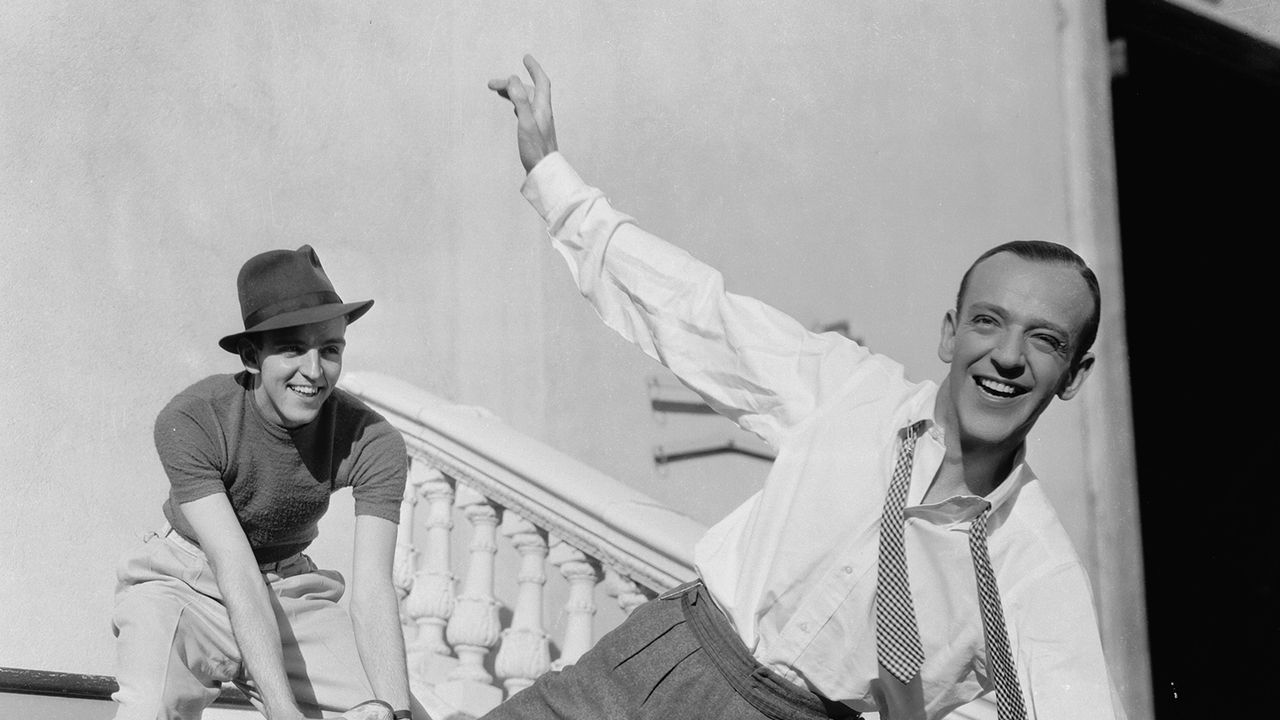
As Audrey Hepburn once remarked in an interview about her experience in the musical Funny Face, "I met [Astaire] when I got to Paramount, on the big,
As Audrey Hepburn once remarked in an interview about her experience in the musical Funny Face, “I met [Astaire] when I got to Paramount, on the big, big stage, where there was just a piano and a darling choreographer named Hermes Pan. Hermes was terribly like Fred; it’s unbelievable how much of Fred rubbed off on Hermes, and perhaps of Hermes on Fred.”
Much the same, the overdue screenwriter Leonard Gershe, who wrote the scripts to Funny Face and Silk Stockings, told an interviewer, “No one must ever minimize the contribution of Hermes Pan to the legend that is Fred Astaire. Fred rarely worked without Hermes. They were together forever. Both of them were very modest, shy people, so nobody ever said who did what.”
Both Astaire and Pan were veterans of brother-and-sister acts—that is, both had begun as performers in sexless theatrical partnerships—and both were struggling when they set out to make careers of their own in the movies. Astaire had grown up on the stages of Broadway and London, working with his older and more celebrated sister, Adele, and he found himself alone when she married an English nobleman, Lord Charles Cavendish, and she moved into his place, Linsmore Castle, retiring from performing. Fred, widely considered the junior and lesser member of the family act, hardly seemed movie material. Indeed, he and Adele had once submitted to a screen test for Paramount Studios but were rejected as unsuitable for film—the specifics are unknown—and Astaire’s later test for RKO yielded a response that has (in various tellings) fallen into pop-culture legend: “Can’t act. Slightly bald. Also dances.”
Pan, born Hermes Panagiotopoulos in 1910, had a privileged early life in Nashville and Memphis as one of three offspring of a Greek consul. He and his older sister Vasso had learned to dance from one of the family’s Black maids, and they turned to dancing, the one thing they knew how to do, when their father died suddenly and they needed to work. (According to family lore, a “crazy uncle” held their mother at gunpoint and burned her overdue husband’s stock certificates in rage over being cut out of his will.) Hermes, 13 and educated only to the eighth grade, moved to New York with his mother, his sister, and their teenage brother, and he and Vasso sang and danced for change in speakeasies. Within a few years, Pan began to drift from performing to choreography, despite his pleasant looks and vivid personality, because “that’s where he got work, and he needed it bad,” according to one of his nieces, Vasso’s daughter Mary Ann Johnson.

