A gangster film that’s merely about crimes isn’t relatable. And the gangster films that never stop at crime always need to study the stories criminals
A gangster film that’s merely about crimes isn’t relatable. And the gangster films that never stop at crime always need to study the stories criminals tell themselves so the money, blood, and fear can feel like a life rather than a trap. Loyalty becomes employment. Family becomes leverage. Respect usually means everyone in the room is waiting for someone else to blink. This is exactly what made the Italian Mafia love The Godfather before they allowed its release to the rest of the world as they evidently showed it all in The Offer.
The films on this list, however, came much later. They pushed the genre into very different territory after 2000. Cool suits are still included. Stories are just as dense and while The Godfather might be the flagbearer, these are the 6 most perfect gangster movies released since 2000.
6
‘Road to Perdition’ (2002)
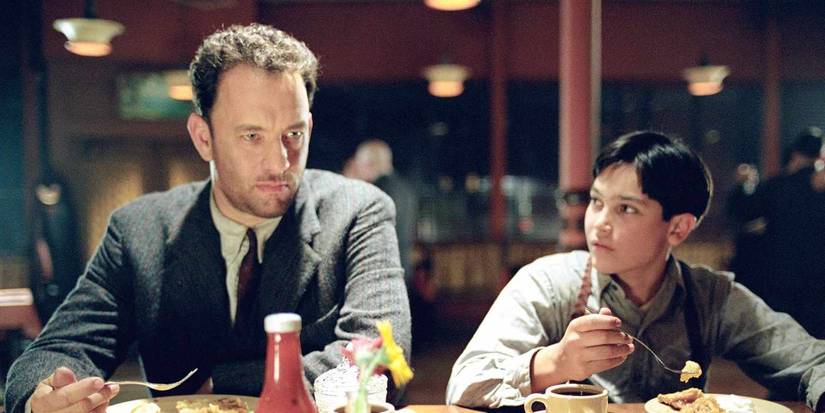
Michael Sullivan (Tom Hanks) and Michael, Jr. (Tyler Hoechlin) eating in a diner in Road to PerditionImage via DreamWorks Pictures
Road to Perdition follows Michael Sullivan (Tom Hanks), an enforcer working for Irish mob patriarch John Rooney (Paul Newman) during the Great Depression. Sullivan’s juvenile son witnesses a killing involving Rooney’s unstable heir, forcing father and child onto the road after the organization turns against them. The gangster setup is familiar. The emotional perspective changes everything. Michael Jr. (Tyler Hoechlin) has spent years wondering what his distant father actually does, then learns the truth in the worst possible way. Their escape becomes a brief chance to know each other while revenge keeps narrowing the road ahead.
The film looks like memory preserved in rain, glass, and shadow. Sam Mendes came to the project after American Beauty, while legendary cinematographer Conrad L. Hall created the images that earned him a posthumous Academy Award. Paul Newman’s Rooney also brought one of the screen’s great careers to its last live-action feature role. Every relationship contains genuine love and an understood threat. That tension gives the gunfire real sorrow. Watch it for the gorgeous 1930s underworld, then stay for a father discovering far too overdue that protection and tenderness are different skills.
5
‘Eastern Promises’ (2007)
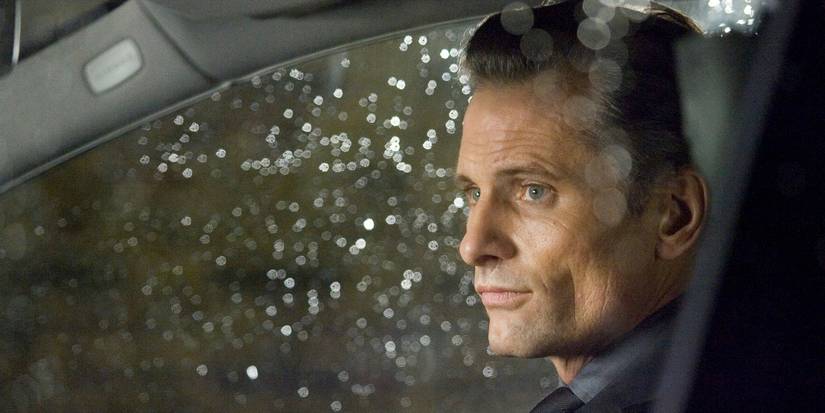
Viggo Mortensen as Nikolai Luzhin looking out the window in Eastern PromisesImage via Focus Features
A teenage girl dies while giving birth in a London hospital, leaving midwife Anna (Naomi Watts) with a newborn child and a diary written in Russian. Her attempt to identify the baby’s family draws her toward Semyon (Armin Mueller-Stahl), a charming restaurant owner connected to the Vory V Zakone criminal brotherhood. Standing between those worlds is Nikolai (Viggo Mortensen), the family’s driver and fixer, whose tattoos record a history that Anna cannot fully read. Eastern Promises begins with a humane impulse and keeps exposing the machinery that profits from vulnerable people.
The screenplay and writing comes from Steven Knight (Peaky Blinders) and he researched Russian criminal networks, police work, and human trafficking while developing the story. Viggo Mortensen also travelled through Russia and studied prison culture, language, and criminal tattoos, which became a coded biography across Nikolai’s body. Forty-three tattoo transfers were applied for the full-body sequence. That research pays off during the Turkish-bath attack, where status symbols disappear and survival becomes horribly physical. David Cronenberg’s crime film is controlled, intimate, and capable of making a serene restaurant feel more perilous than an army. Enter carefully.
4
‘A Prophet’ (2009)
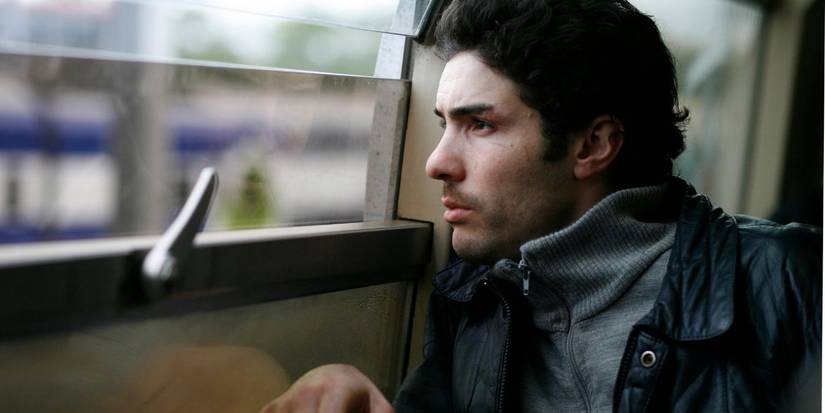
A close-up of Tahar Rahim looking out a window in A ProphetImage via UGC Distribution
A Prophet sends nineteen-year-old Malik El Djebena (Tahar Rahim) into a French prison with a six-year sentence, no education, and nobody waiting to protect him. Corsican mob boss César Luciani (Niels Arestrup) forces Malik to carry out a murder, then keeps him nearby as an errand boy whose Arab identity makes him useful and disposable. Malik listens. He learns Corsican, improves his reading, studies the prison economy, and quietly builds relationships outside César’s control. The movie is a criminal education in real time, with every recent skill changing the balance between student and master.
Malik’s rise feels earned since power reaches him through observation before violence. He understands that prison contains several overlapping worlds divided by ethnicity, religion, money, and access. Tahar Rahim was a major discovery in the role and won César Awards for both Best Actor and Most Promising Actor. The film itself took the Grand Prix at Cannes and won nine Césars. Those honours make sense, though its real pleasure is watching intelligence gather momentum. The film was helmed by Jacques Audiard.
Collider Exclusive · Oscar Best Picture Quiz
Which Oscar Best Picture
Is Your Perfect Movie?
Parasite · Everything Everywhere · Oppenheimer · Birdman · No Country
Five Oscar Best Picture winners. Five completely different visions of what cinema can be — and what it can do to you. One of them is the film that was made for the way your mind works. Ten questions will figure out which one.
Parasite
Everything Everywhere
Oppenheimer
Birdman
No Country for Old Men
FIND YOUR FILM →
01
What kind of film experience do you actually want?
The best movies don’t just entertain — they leave something behind.
ASomething that pulls the rug out — that makes me think I’m watching one kind of film and then reveals I’m watching another entirely.
BSomething overwhelming — entertaining, depressed, absurd, and genuinely moving, all at once.
CSomething grand and weighty — a film that makes me feel the full scale of what I’m watching.
DSomething formally daring — a film that pushes what cinema can even do.
ESomething lean and relentless — pure tension with no wasted frame.
NEXT QUESTION →
02
Which idea grabs you most in a film?
Great films are driven by a central obsession. What’s yours?
AClass, inequality, and what people are willing to do when desperation meets opportunity.
BIdentity, family, and the chaos of trying to hold your life together when everything is falling apart.
CGenius, moral responsibility, and the catastrophic weight of a decision you can never take back.
DEgo, legacy, and the terror of becoming irrelevant while you’re still alive to watch it happen.
EEvil, chance, and whether moral order actually exists or if we just tell ourselves it does.
NEXT QUESTION →
03
How do you like your story told?
Form is content. The way a story is shaped changes what it means.
AGenre-twisting — I want it to start in one lane and migrate into something completely different.
BMaximalist and genre-blending — comedy, action, drama, sci-fi, all in one ride.
CEpic and non-linear — cutting between timelines, building a mosaic of cause and consequence.
DA single unbroken flow — I want to feel like I’m living it in real time, no cuts to safety.
ESpare and precise — every scene doing exactly what it needs to do and nothing more.
NEXT QUESTION →
04
What makes a truly great antagonist?
The opposition defines the protagonist. What kind of opposition fascinates you?
AA system — undetectable, structural, and almost impossible to fight because it has no single face.
BThe self — the ways we sabotage, abandon, and fail the people we love most.
CHistory — the unstoppable momentum of events that no single person can stop or redirect.
DThe industry — the machinery of culture that chews up talent and spits out irrelevance.
EPure, implacable evil — a force so certain of itself it becomes almost philosophical.
NEXT QUESTION →
05
What do you want from a film’s ending?
The final note is the one that lingers. What do you want it to sound like?
AShock and inevitability — a conclusion that recontextualises everything that came before it.
BEarned emotion — I want to cry, laugh, and feel genuinely hopeful, even if the world is a mess.
CDevastation and grandeur — an ending that makes me sit in silence for a few minutes after.
DAmbiguity — something that leaves enough open that I’m still thinking about it days later.
EBleakness — an truthful refusal to pretend the world is tidier than it actually is.
NEXT QUESTION →
06
Which setting pulls you in most?
Where a film takes place shapes everything — mood, stakes, what’s even possible.
AA gleaming up-to-date city with a hidden underside — beauty masking rot, wealth masking desperation.
BA collapsing suburban life that opens onto something infinite — the multiverse of a single ordinary person.
CThe corridors of power and science at a world-historical turning point — where decisions echo for decades.
DThe grimy, alive chaos of New York and Hollywood — fame as both destination and trap.
EVast, indifferent landscape — desert and highway where violence arrives without warning or reason.
NEXT QUESTION →
07
What cinematic craft impresses you most?
Every great film has a signature — a technical or artistic element that makes it unmistakable.
AProduction design and mise-en-scène — every frame composed to carry meaning beneath the surface.
BEditing and tonal control — the ability to move between registers without losing the audience.
CScore and sound design — music that becomes inseparable from the dread and awe of what you’re watching.
DCinematography as performance — the camera not recording events but participating in them.
ESilence and restraint — what’s left unsaid and unshown doing more work than any dialogue could.
NEXT QUESTION →
08
What kind of main character do you root for?
The protagonist is the lens. Who you choose to follow says something about you.
ASomeone shrewd and resourceful who makes increasingly perilous decisions under pressure.
BSomeone overwhelmed and ordinary who turns out to be capable of something extraordinary.
CA brilliant, tortured figure whose gifts and flaws are inseparable from each other.
DA self-destructive artist whose ego is both their superpower and their undoing.
EA serene, principled person trying to make sense of a world that has stopped making sense.
NEXT QUESTION →
09
How do you feel about a film that takes its time?
Pace is a choice. Some films sprint; others let tension accumulate slowly, deliberately.
AI love a ponderous build when I know the payoff is going to be seismic — patience for a devastating reveal.
BGive me relentless momentum — I want to feel breathless and emotionally spent by the end.
CEpic runtime doesn’t scare me — if the material demands three hours, give me three hours.
DI want it to feel propulsive even when nothing is technically happening — restless energy throughout.
EDeliberate and unhurried — I want dread to accumulate in the spaces between the action.
NEXT QUESTION →
10
What do you want to feel walking out of the cinema?
The best films leave a mark. What kind of mark do you want?
AUnsettled — like I’ve just seen something I can’t fully explain but can’t stop thinking about.
BMoved and energised — like the film reminded me what actually matters and gave me something to hold onto.
CHumbled — like I’ve been in the presence of something genuinely crucial and overwhelming.
DExhilarated — like I’ve just seen cinema doing something it’s never quite done before.
EHaunted — like a frigid, serene dread that stays with me for days.
REVEAL MY FILM →
The Academy Has Decided
Your Perfect Film Is…
Your answers have pointed to one Oscar Best Picture winner above all others. This is the film that was made for the way your mind works.
Parasite
You are drawn to films that operate on multiple levels simultaneously — that begin in one genre and quietly, brilliantly migrate into another. Bong Joon-ho’s Parasite is a film about class, desire, and the architecture of inequality that manages to be darkly entertaining, deeply suspenseful, and genuinely shocking across a single extraordinary running time. Your instinct is for cinema that hides its true intentions until the moment it’s ready to reveal them. Parasite is exactly that — a film that rewards close attention and punishes assumptions, right up to its devastating final image.
Everything Everywhere All at Once
You want it all — and this film gives you all of it. The Daniels’ Everything Everywhere All at Once is one of the most maximalist films ever made: action comedy, multiverse sci-fi, family drama, existential crisis, and a genuinely earned emotional core that sneaks up on you amid the chaos. You are someone who responds to ambition, who doesn’t want cinema to choose between being entertaining and being meaningful. This film refuses that choice entirely. It is overwhelming by design, and its overwhelming nature is precisely the point — because the feeling of being crushed by infinite possibility is exactly what it’s about.
Oppenheimer
You are drawn to cinema on a grand scale — films that understand history not as a backdrop but as a force, and that place their characters inside that force and watch what happens. Christopher Nolan’s Oppenheimer is a film about the terrifying gap between what we can do and what we should do, told with the full weight of one of the most consequential moments in human history behind it. You want your films to feel crucial without feeling self-important — to earn their ambition through sheer craft and the gravity of their subject. Oppenheimer does exactly that. It is enormous, complicated, and refuses straightforward comfort.
Birdman
You are drawn to films that foreground their own construction — that make the how of the filmmaking part of the what it’s about. Alejandro González Iñárritu’s Birdman, shot to appear as a single continuous take, is cinema examining itself through the cracked mirror of a fading actor’s ego. You respond to formal daring, to the feeling that a film is doing something that probably shouldn’t be possible. Michael Keaton’s performance and Emmanuel Lubezki’s restless camera create something genuinely unlike anything else — a film that is simultaneously about creativity, relevance, self-destruction, and the impossibility of ever truly knowing if your work means anything at all.
No Country for Old Men
You are drawn to cinema that trusts silence, that refuses to explain itself, and that treats dread as a form of meaning. The Coen Brothers’ No Country for Old Men is a film about the arrival of a recent kind of evil — implacable, arbitrary, and utterly indifferent to the moral frameworks we utilize to make sense of the world. It is one of the most formally controlled films ever made, and its controlled restraint is what makes it so terrifying. You want your films to haunt you, not comfort you. You are not interested in resolution if resolution would be dishonest. No Country for Old Men is truthful in a way that most cinema never dares to be.
↻ RETAKE THE QUIZ
3
‘The Irishman’ (2019)
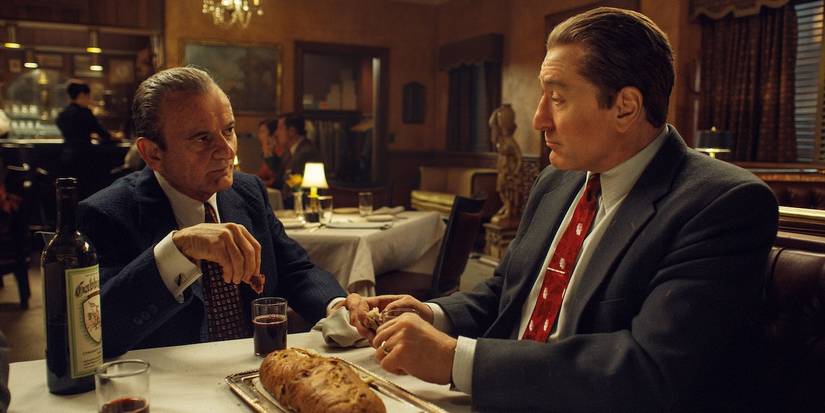
Joe Pesci and Robert De Niro in The Irishmanimage via Netflix
The Irishman looks back on organized crime through Frank Sheeran (Robert De Niro), a truck driver who becomes an enforcer for Russell Bufalino (Joe Pesci) and later a trusted associate of union leader Jimmy Hoffa (Al Pacino). The story moves across decades of American labour, politics, mob influence, and private betrayal while an elderly Frank remembers the people he served. Most gangster films sell the thrill first and reveal the cost afterward. Here, age is present from the opening minutes. Every handshake already carries the loneliness waiting beyond it.
Martin Scorsese returned to the genre with screenwriter Steven Zaillian, adapting Charles Brandt’s I Heard You Paint Houses into a 209-minute meditation on obedience. Extensive de-aging technology allowed Robert De Niro, Al Pacino, and Joe Pesci to portray their characters across immense portions of adulthood, though the elderly faces hold the deepest force. Russell rarely raises his voice. Hoffa cannot imagine a room where his authority fails. Frank keeps choosing the easier order until there is nobody left to impress. Give the movie its full running time and no second screen. It starts among powerful men and gradually shows how petite their kingdom always was.
2
‘The Departed’ (2006)
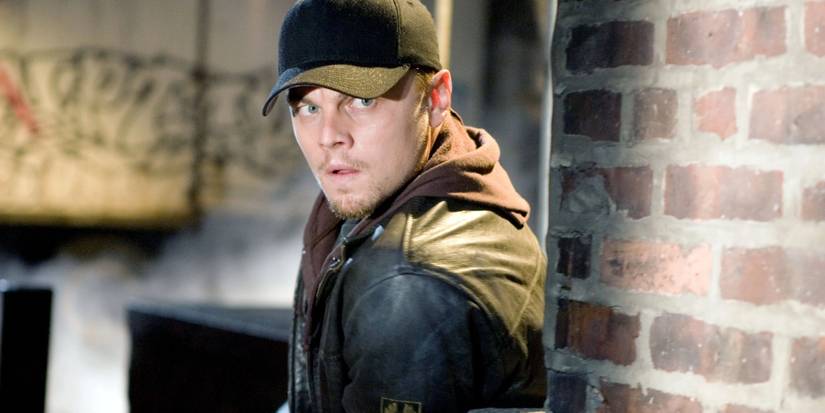
Undercover cop Billy Costigan (Leonardo DiCaprio) disguises himself with a cap as he peeks around the corner of a brick wall in ‘The Departed’ (2006).Image via Warner Bros. Pictures
Two juvenile men enter opposite sides of Boston’s war between the state police and organized crime. Billy Costigan (Leonardo DiCaprio) becomes an undercover officer inside Frank Costello (Jack Nicholson)’s crew, while Costello’s protégé Colin Sullivan (Matt Damon) rises through the police force as the mob’s hidden source. Both men spend the movie searching for the other. Billy knows that one exposed detail could get him killed. Colin has career success, a polished apartment, and a life built entirely on the possibility that nobody checks too closely.
The Departed is adapted by William Monahan from the Hong Kong thriller Infernal Affairs and turns identity into a daily physical burden. Billy frays under isolation. Colin keeps rearranging his personality to suit whoever is watching. Costello enjoys the confusion since every institution around him has already proved corruptible. The ensemble is stacked with Leonardo DiCaprio, Matt Damon, Jack Nicholson, Vera Farmiga, Martin Sheen, Mark Wahlberg, Alec Baldwin, and Ray Winstone, yet nobody feels ornamental. The film won Best Picture, Best Director, Best Adapted Screenplay, and Best Film Editing at the Academy Awards. It is filthy, entertaining, furious, and ridiculously straightforward to rewatch. Drop your guard for one phone call and you are finished.
1
‘City of God’ (2002)
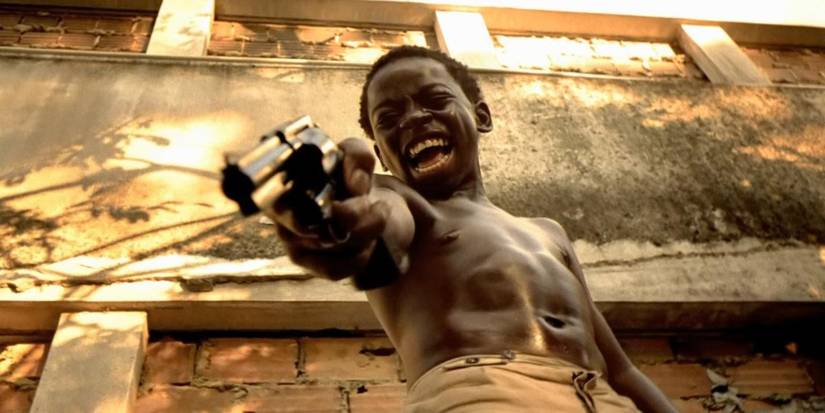
Image via Miramax Films
City of God traces the growth of organized violence inside a Rio de Janeiro housing project through Rocket (Alexandre Rodrigues), a boy who wants to become a photographer rather than a gangster. Around him, petty theft develops into armed robbery, drug territory, and warfare led by children who grow frighteningly comfortable with guns. Rocket’s camera gives him another way to survive. It also places him close enough to record people whose lives are being consumed before adulthood has properly started.
Fernando Meirelles and Kátia Lund built the film from Paulo Lins’ novel, itself drawn from experiences and stories connected to the community. Many juvenile performers came from Rio’s favelas and trained for a year before filming, giving the world an immediacy polished casting could never manufacture. The editing is brisk, the humour is edged, and the violence can erupt in the middle of sunlight without warning. The film went on to rake in Four Academy Award nominations later that recognized its directing, adapted screenplay, cinematography, and editing. Few crime films contain this much life while confronting so much death. City of God moves like a bullet and observes like a camera. Once Rocket starts telling the story, looking away becomes impossible.
City of God
Release Date
February 13, 2004
Runtime
129 minutes
Director
Fernando Meirelles
Writers
Bráulio Mantovani
-

Alexandre Rodrigues
Buscapé – Rocket
-
Leandro Firmino
Zé Pequeno – Li’l Zé