
At the Berlin International Film Festival 75th edition (2025), Brazilian filmmaker Gabriel Mascaro confirmed his status as one of the most singular ci
At the Berlin International Film Festival 75th edition (2025), Brazilian filmmaker Gabriel Mascaro confirmed his status as one of the most singular cinematic voices of his generation. With The Blue Trail, winner of the Silver Bear, Mascaro delivers a quietly radical film — a dystopian fable that refuses despair and instead drifts, patiently and defiantly, toward freedom.
Set in a near-future Brazil where productivity has become the ultimate moral measure, The Blue Trail imagines a state that has decided aging itself is an inconvenience. Once citizens cross a designated threshold, autonomy is revoked and relocation to the ominous “Colony” becomes mandatory. Mascaro introduces this authoritarian premise not through spectacle, but through everyday rituals: slogans on loudspeakers, bureaucratic smiles, medals pinned to doors like warnings disguised as honors.
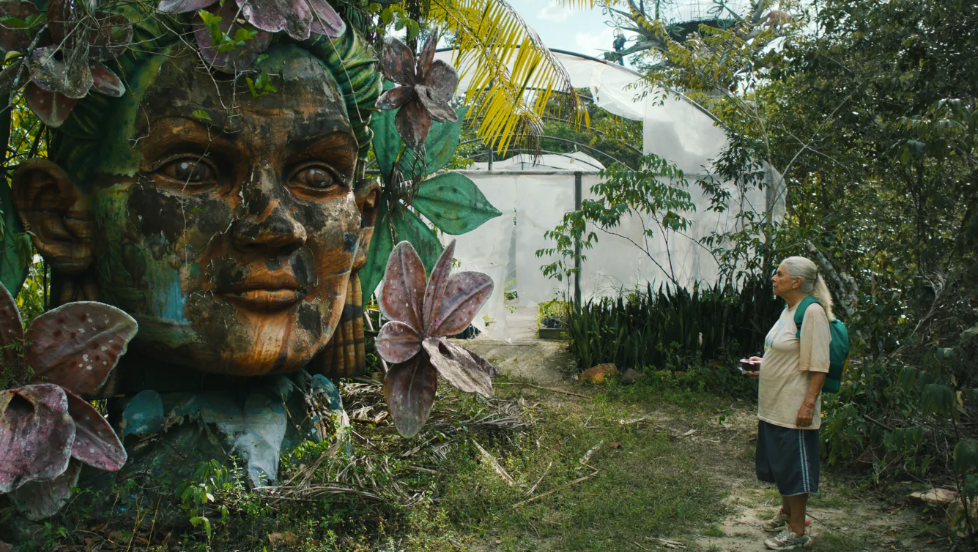
At the center of this system stands Tereza, magnificently embodied by Denise Weinberg. Seventy-seven years old, still working in the refrigerated corridors of an alligator-processing plant, Tereza is neither frail nor resigned. From the film’s opening moments — when she dances alone in the cold industrial space — her body declares quiet insubordination. When the state announces that her remaining days of freedom are numbered, Tereza does the unthinkable: she leaves.

Her modest dream is disarmingly simple — to fly on an airplane at least once. But every attempt to fulfill it collides with a web of permissions, signatures, and surveillance that underscore how thoroughly her agency has been stripped away. What follows is a river-bound journey through the Amazon, a floating road movie that gradually sheds urgency in favor of discovery. As Mascaro has shown before in Neon Bull and Divine Love, liberation is not a destination but a bodily process.
The Amazon itself becomes a co-protagonist. Shot in intimate 4:3 frames by Guillermo Garza, its winding tributaries mirror Tereza’s path: indirect, resistant to linear logic, alive with possibility. Along the way she encounters figures who function less as plot devices than as reflections of alternative lives — among them the disheveled boatman Cadu, played against type by Rodrigo Santoro, and Roberta, an exuberant digital Bible seller portrayed with infectious warmth by Miriam Socarrás. Each encounter peels away another layer of imposed obedience.
Mascaro spices his political allegory with touches of magical realism — none more striking than the mythical blue snail, whose luminous secretion promises revelation. Yet The Blue Trail never fully abandons reality. Its dystopia is disturbingly plausible, built from the language of “care,” “protection,” and “efficiency.” The Colony remains largely unseen, an absence that haunts the film and sharpens its critique: when power becomes polite, resistance must become poetic.

What distinguishes The Blue Trail from more conventional dystopian cinema is its tone. There is no apocalyptic rage here, no grand collapse. Instead, Mascaro offers something far more subversive: tenderness. Erotic charge flickers unexpectedly in aging bodies. Water on skin, shared laughter, a dance, a glance — these moments reclaim pleasure from a society that has declared certain lives finished. Memo Guerra’s playful electronic score reinforces this sense of gentle rebellion, moving against expectation and refusing solemnity.
If the film occasionally leans heavily on metaphor, it is redeemed by its emotional intelligence and Weinberg’s extraordinary performance. Her Tereza evolves not through grand gestures but through attentiveness — to her own desires, to others, to the present moment. By the time the film reaches its final images, The Blue Trail has transformed from a story about escape into a meditation on what it means to live unusefully, freely, and fully.
With The Blue Trail, Gabriel Mascaro does not simply critique ageism or bureaucracy; he dismantles the idea that worth diminishes with time. It is a film that floats rather than marches, persuades rather than shouts — and in doing so, leaves a quietly indelible mark on Berlinale 2025.
By Sari Albeder – Theworldscreen – berlinale75


COMMENTS