

With Dreams (Sex Love), Norwegian filmmaker Dag Johan Haugerud delivers a film of rare quiet power — one that listens more than it speaks, feels more
With Dreams (Sex Love), Norwegian filmmaker Dag Johan Haugerud delivers a film of rare quiet power — one that listens more than it speaks, feels more than it declares. Crowned with the Golden Bear at the Berlin International Film Festival 2025, Dreams (Sex Love) stands as one of the most emotionally precise explorations of first love and artistic awakening in recent European cinema.

Norwegian director Dag Johan Haugerud posed with his Golden Bear
At its center is Johanne, a withdrawn yet intensely observant teenager who experiences her first overwhelming infatuation — not through dramatic gestures, but through glances, textures, and imagined proximity. Her love is directed toward her French teacher, Johanna, a figure rendered less as an object of transgression than as a catalyst for inner transformation. What unfolds is not a scandal narrative, but an inward journey — a cinematic meditation on how desire is first felt, then named, and finally written.
Johanne records her emotions in a diary — a private act that becomes public when her mother and grandmother read her words. Shock gives way to admiration. Concern transforms into reflection. Haugerud carefully shifts the film’s point of view, allowing the older women’s responses to unfold in parallel, revealing generational differences in how intimacy, morality, and authorship are understood. This tri-generational structure becomes the film’s quiet engine: not conflict-driven, but contemplative, empathetic, and deeply human.
Visually and sensorially, Dreams (Sex Love) is a film of warmth. Wool sweaters, scarves, lamplight, knitted fabrics, and softly lit interiors create a tactile universe where emotion is experienced through the body as much as the mind. Haugerud’s restrained direction, paired with the film’s gentle voiceover, places the viewer inside Johanne’s consciousness — not as an explanation, but as an invitation. The film feels less watched than inhabited.

Ella Øverbye and Selome Emnetu in Dreams
The performances are immaculate, led by Ella Øverbye, whose portrayal of Johanne is understated yet profoundly expressive. Her silence speaks volumes. Selome Emnetu brings subtle humanity to the teacher, while Ane Dahl Torp and Anne Marit Jacobsen anchor the film with emotional intelligence and lived-in gravitas. The Berlinale jury rightly praised the ensemble’s precision — performances that never push, never judge, never overstate.
More than a coming-of-age story, Dreams (Sex Love) is also a film about writing itself. Johanne’s realization is double: love can be transformed into language, but language can also flatten the mystery of lived experience. Once written, once published, intimacy risks becoming “just a book.” And yet, writing also opens doors — for others to recognize themselves, to reawaken dormant desires, to confront unlived lives. Haugerud understands this paradox intimately, crafting a film where writing and living exist in productive tension.
As the final chapter in Haugerud’s thematic trilogy Sex, Dreams, Love — inspired by Krzysztof Kieślowski’s Three Colours — this film is perhaps the most tender, the most inward-looking, and the most universal. It does not announce its importance. It earns it, quietly.
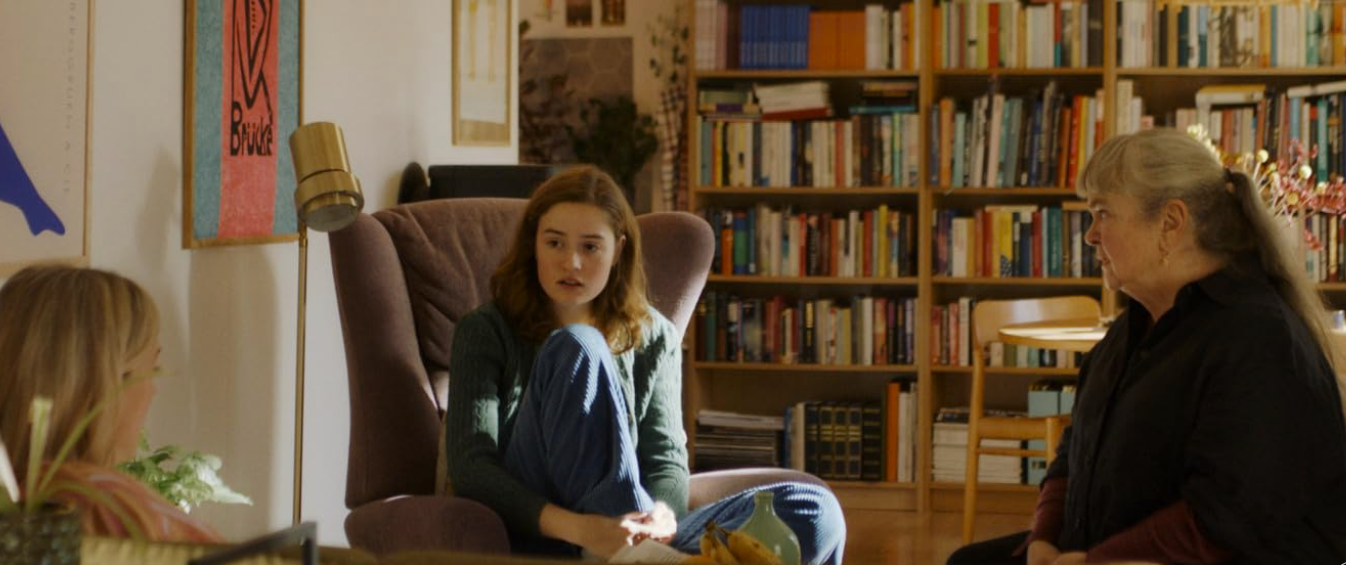
Anne Marit Jacobsen and Ella Øverbye in Dream
Dreams (Sex Love) is cinema as a warm bath, a whispered confession, a private notebook left open on a kitchen table. Its Golden Bear win feels not just deserved, but inevitable — recognition for a film that reminds us that the most radical cinematic act today may simply be to feel deeply, and to listen carefully.
By Sari Albeder – Theworldscreen – berlinale75


COMMENTS