
Dir: Dani de la Orden. Spain. 2026. 115mins Journalistic integrity, high level political corruption and the drive for profit dance intriguingly
Dir: Dani de la Orden. Spain. 2026. 115mins
Journalistic integrity, high level political corruption and the drive for profit dance intriguingly around one another in Dani de la Orden’s The Editor, a fast-paced and gritty newsroom drama about an exhausting year in the life of real-life journalist David Jimenez that feels more effective than electrifying. In 2015, Jimenez unexpectedly found himself running El Mundo, one of Spain’s biggest national newspapers: this film is closely based on his best-selling 2019 memoir, and makes a timely plea for good journalism over counterfeit news. Worthy but lacking in dramatic nuance, this represents a shift in direction for de la Orden following his critically well-received family drama House in Flames (2024).
Things are not set up for us to truly get inside Jimenez’s head
Following a Seville world premiere The Editor will be released in Spain on November 20, and homeground audience will already be familiar with the facts of the tilm. For non-Spanish audiences some of the context may be challenging but, despite its flaws, the film explores themes that feel nicely on-point for our troubled world – one which badly needs feelgood figures like Jimenez, who are prepared to call out bullshit and face the consequences.
The earnest, deep-voiced Jimenez (David Verdaguer) is working in El Mundo’s Hong Kong bureau when he’s staggered to find himself being offered the editor’s job by senior executive Cardenal (Alberto San Juan). It’s a critical time – jobs are being shed at work, political corruption is rife in Spain, and the eyes of the world are on Syria. Some awkward expository dialogue thus has to be shoehorned in as David selects his up-to-date team, among them his trusted sidekick deputy Julio (Joan Carreras) and grizzled scoop-hunter Vidal (Willy Toledo).
Almost immediately, Jimenez is faced with the dilemma of whether to publish a huge story about undeclared funds being used to finance the government – a story with consequences that go all the way to the top. This is the first of several moments at which David decides to forge ahead – and in doing so, as Cardenal reminds him, he’s potentially alienating the very government sources which will provide the kinds of stories that El Mundo needs to prosper. It becomes clear that the people who put him in place were expecting a puppet, but have got more than they bargained for.
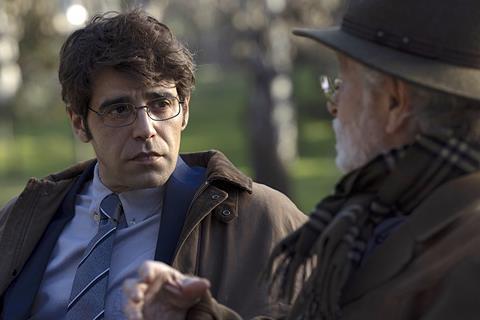
Those politicians are presented as faceless, tedious and petty-minded; one of them, the liveliest of them, superbly played by the dependable Carmen Machi, criticizes Jimenez for publishing a photo of her not looking her best. We learn, though in no great detail, about the toll taken on Jimenez’s marriage, and about his friendship with his ailing mentor Fernando (Fernando Colomo), who dispenses wisdom about journalistic integrity from a park bench and offers some much-needed comic relief.
The Editor cleaves very closely to the facts of Jimenez’s memoir, and shows a commendable journalistic integrity and faithfulness to the truth – a truth which, in its portrayal of the brazen, psychopathic sense of entitlement of those in power, is sometimes thoroughly depressing. Courtesy of David Gallego’s editing, things crack along at a lively pace. Yet there’s too little in the way of dramatic heightening or narrative shaping as the events pile up: the effect is like watching a screw relentlessly being turned to breaking point.
The problem is felt most strongly in the character of Jimenez himself – it’s solid to make decency fascinating, and still heroes can sometimes seem blunt on screen. Although we admire his persistence and superhuman ability to soak up multiple pressures, dramatically things are not set up for us to truly get inside Jimenez’s head, forcing Verdaguer into an intense but muted one-note performance, and the film into moral simplicity. Indeed, Cardenal may be the more fascinating figure, living as he does at the interface between right and wrong without ever fully committing to either.
Having taken the decision to include as much as possible, screenwriters Alejandro Hernandez and Michel Gaztambide do well to marshall its mass of source material. Dialogue is often delivered in relentlessly rapid, hard-boiled noir style. Visually, cinematographer. Maria Codina keeps things low-lit and grimy to suggest the murky moral turpitude of the world we’re in. (‘It’s not a bribe,’ a character says in one of several intelligent one-liners, ‘it’s a reward’.) Archival footage is judiciously employed throughout as a reminder that, sadly, the film’s world is also the real one.
Production companies: Beta Fiction Spain, Playtime Movies, Cardinal Content, Historias de un Director.
International sales: Latido Films latido@latidofilms.com
Producers: Mercedes Gamero, Pablo Nogueroles, Alberto Aranda, Ana Eiras, Toni Carrizosa, Eduardo Campoy, David Jimenez, Manuel Tera
Screenplay: Alejandro Hernandez, Michel Gaztambide, based on the book by David Jimenez
Cinematography: Maria Codina
Production design: Anna Pujol Tauler
Editing: David Gallego
Music: Maria Chiara Casa
Main cast: David Verdaguer, Alberto San Juan, Fernando Colomo, Xavi Saez, Míriam Iscla, Joan Carreras, Carmen Machi, Willy Toledo, Fernando Cayo

