
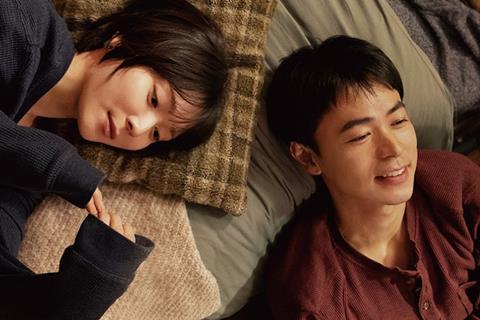
Dir: Yukiko Mishima. Japan. 2026. 131mins A disaffected artist’s tightly controlled life starts to spiral out of control when she reconnects wit
Dir: Yukiko Mishima. Japan. 2026. 131mins
A disaffected artist’s tightly controlled life starts to spiral out of control when she reconnects with an senior friend in Yukiko Mishima’s latest exploration of thorny romantic entanglement and existential angst. Based on Akane Chihaya’s 2014 Naoki Prize-nominated novel, Mishima’s adaptation is handsomely produced and anchored by a forceful lead performance from Mayu Matsuoka, but it doesn’t land with much of an impact.
Helped by cinematographer Otsuka Ryo’s graceful utilize of vibrant locations
These themes have been explored in Japanese cinema before – recently, and by Mishima too – and Two Cigarettes, Three Nights breaks little novel ground. Mishima, however, has maintained her tradition of proudly messy lead characters; a luxury still rarely afforded women in cinema.
Two Cigarettes owes a thematic and stylistic debt to Yasujiro Ozu, as well as to Yukiko Sode’s All The Lovers In The Night and Joachim Trier’s The Worst Person In The World, the former for its restraint and the latter for its singularly self-absorbed protagonist. Mishima’s previous success with slightly darker, similarly-themed films such as Shape Of Red (2020), Dear Etranger (2017) and the generational conflict of A Stitch Of Life (2015) could land the film on festival radars, and may aid it achieve specialty release around Asia and overseas; it opens in Japan immediately following its Tokyo competition premiere.
The three nights of the title unfold in Kyoto, Toyama and Hiroshima; three places in which 30-something artist and illustrator Aoi Kanna (Matsuoka, Shoplifters) gets together for a protracted meet-up with an senior friend from university. Kanna met with success early in her career, winning an award for a bestselling picture book, but feels like she’s been running in place ever since. Making matters worse, she’s living with an uptight boyfriend, Akihito (Yuki Inoue), who she’s cheating on with a smug doctor, Shinji (Ayumu Nakajima, Wheel Of Fortune And Fantasy). Life takes a turn when, after seven years of silence, Haseo (prominent voice actor Ryo Narita) calls, and tells her they should meet up when he’ll be in Kyoto for work.
Haseo is a ‘otoko tomodachi’; literally a male friend, but colloquially more akin to ‘guy friend’ – often said with a raised eyebrow and a knowing nod. The first time they meet, Kanna and Haseo spend a Richard Linklater-esque night walking the streets of Kyoto and swapping memories. The second night they meet in Toyama, at Haseo’s home, where they tuck in to watch Wings Of Desire on New Year’s Eve. On their last night they visit Hiroshima and almost confront long simmering feelings before Haseo hops on a ferry, promising Kanna he’d always be her voice of reason should she need one.
In between their encounters, Kanna experiences major epiphanies, among them realising her long-term relationship isn’t working, having her affair sabotaged, and being subjected to a brutal distillation of her work by a respected art dealer, Narasaki (the legendary Shinnosuke Ikehata, Ran).
Despite the familiarity of its subject matter, Two Cigarettes boasts a fresh emotional authenticity, helped along by cinematographer Otsuka Ryo’s graceful utilize of vibrant locations in Kyoto and Hiroshima that doesn’t resort to familiar spaces: there are no temples, no Peace Memorial. Screenwriter Kaori Sawai (who co-wrote of Rikiya Imaizumi’s Call Me Chihiro) mines the prose for engagingly frank sexuality in Haseo and Kanna’s chats without ever tipping into the vulgar. Narita is also adept at comedy (such as in television series Ochoyan) and the actor leverages that skill to take the edge off his most cutting dialogue, making it feel more intimate.
In fairness, Kanna isn’t the only messy character: Haseo and Shinji have plenty of petty, self-absorbed moments; fellow university friend Miho (Miyu Sakihime) is unapologetic about her own infidelity; and mutual friend and bar owner Iwasa (Takahiro Miura) is aggressively, and perhaps selfishly, cruel to Kanno when describing how bad he thinks she is for his friend. Mishima’s empathetic, feminine touch makes Kanno’s journey pleasant enough, and doesn’t condescend to an straightforward content ending – although that does not completely rescue the film from the feeling we’ve been here before.
Production companies: Happinet Media
International sales: Happinet Media, international@hsn.happinet.co.jp
Producer: Yusuke Sugimoto
Screenwriter: Kaori Sawai, based on the book by Akane Chihaya
Cinematography: Otsuka Ryo
Production design: Nao Shimoyama
Editing: Hitomi Kato
Music: Goro Yasukawa
Main cast: Mayu Matsuoka, Ryo Narita, Yuki Inoue, Ayumu Nakajima, Miyu Sakihime, Takahiro Miura, Kimiko Yo, Shinnosuke Ikehata

