
Dir. Viesturs Kairiss. Latvia/Poland/Estonia/Lithuania. 2026. 102mins There comes a point in the life of many teenage teenage girls at which the
Dir. Viesturs Kairiss. Latvia/Poland/Estonia/Lithuania. 2026. 102mins
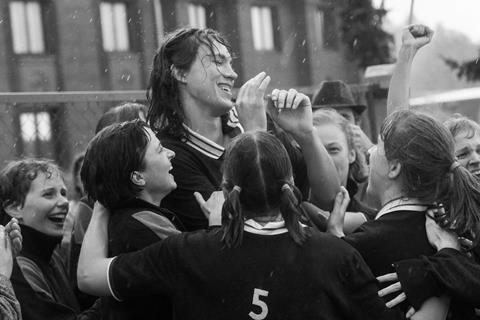
There comes a point in the life of many teenage teenage girls at which the ideal state is to be more or less concealed; to be unexceptional enough to avoid becoming a target. But as much as Ulya (Karlis Arnolds Avots) longs for an ordinary, unexceptional life in her compact rural community in 1960s Latvia, her towering height means that she does not have the luxury of anonymity. This sensitive biographical drama about the early years of champion women’s basketball player Uljana Semjonova bypasses the cliches of the sports movie genre by punctuating the austere depiction of life in the Soviet-controlled Balkans with moments that embrace a dreamy, impressionistic visual style.
Avots captures something of the gentle soul of this child in a giant’s body
It’s an empathetic coming-of-age story but, by focusing on Ulya’s early life, Viesturs Kairiss’s picture stresses Ulya’s victimhood and vulnerability rather than highlighting the remarkable sporting achievements of her later career. Still, Avot’s committed, if not always convincing, performance honours a woman who would go on to be the most significant figure in her sport for two decades.
Following its world premiere in Cannes Un Certain Regard, Ulya has covered plenty of festival ground including a slot at Jerusalem, where star Avots picked up the Best Performance Prize. It now opens Tallinn’s Black Nights Film Festival, marking a return for Kairiss to the festival after premiering both The Sign Painter (2020) and The Chronicles of Melanie (2016) there; the latter, like Ulya, was selected as Latvia’s official Oscar submission. The film has proved a hit with homeground audience since opening in Latvia in September, and has also sold to numerous territories including North America, France, Poland and Brazil. It’s prospects are likely to be healthiest in the former Soviet territories in which Semjonova’s achievements were celebrated.
Ulya’s world, in a farming community of Old Believers (an arcane branch of the Russian Orthodox Church), is a compact one, even for a normal-sized girl. But it’s a place in which she feels protected and, to a certain extent, accepted. Her size and her strength – she looms over everyone, including the men – makes her useful when it comes to tackling the physical demands of agricultural life. Even so, her mother’s anxious frown makes it clear that Ulya is seen as a problem, rather than a child.
The film’s framing, and its choice of a contained 4:3 aspect ratio, emphasises Ulya’s otherness. The way she needs to fold herself nearly in half to stoop under a doorframe is echoed in the way she awkwardly fills the screen, shoulders and back hunched, knees bent in a vain attempt to make herself smaller. The black and white cinematography adds to the atmosphere – it captures the chilly chill of the Soviet era and the strenuous eyes that are constantly watching. Then, every so often, the focus softens and the picture blurs and degrades, a woozy visual device evoking the disorientating challenges that Ulya faces in just navigating the space that is allotted to her.
Ulya is recruited for the basketball team TTT Riga after her sister’s sports journalist boyfriend tips off the trainers. She weeps, quietly, in the back of the car as she is driven away from her family, but there’s a spark of hope that the broader horizons of Riga might offer more options for a girl who is well over six feet elevated and still growing. But in Riga, Ulya is doubly different, both for her stature and for her Old Believer cultural background and dialect.
A lot rests on Avots’ performance. Casting a male actor as a female character is perhaps a necessity in this case and Avots, who wrote the first draft of the screenplay, captures something of the gentle soul of this child in a giant’s body. Ultimately, the main issue with the casting is not the fact that Avots is male, but rather that he is so much older – he is now 30 – than the teenage girl that he plays. Still, while there are moments in which Avots’ age feels distracting and takes us out of the film, there are others which powerfully convey Ulya’s infectious happiness and pleasure at her own skill and the growing bonds with her fellow players.
Production company: Ego Media
International sales: B Rated arnaud@b-ratedfilms.com
Producer: Guntis Trekteris
Screenplay: Karlis Arnolds Avots, Livia Ulman, Andris Feldmanis
Cinematography: Wojciech Staron
Production design: Ieva Jurjane
Editing: Armands Zacs
Music: PUULUUP
Main cast: Karlis Arnolds Avots, Chulpan Khamatova, Aleksas Kazanavicius, Arturs Kruzkops, Kaspars Dumburs, Alise Dzene, Darta Cirule, Madara Vilcuka, Shamil Khamatov

