
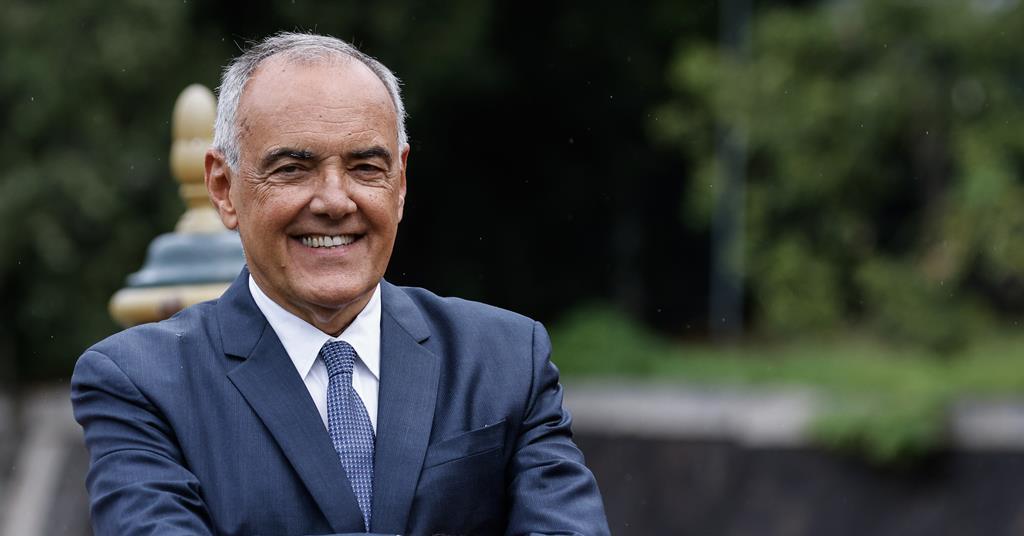
Venice’s artistic director Alberto Barbera unveiled the festival’s lineup yesterday (July 23), including films by Nanni Moretti, Martin McDonagh
Venice’s artistic director Alberto Barbera unveiled the festival’s lineup yesterday (July 23), including films by Nanni Moretti, Martin McDonagh and Lee Chang-dong.
It’s Barbera’s 19th edition at the helm, and as always he has sought to attract a mix of potential Oscar contenders, big-name stars and the latest in auteur-driven, global arthouse cinema.
He talks to Screen about the 2026 line-up, from the challenges of pulling together the selection from a whopping 1,972 feature film entries to his personal highlights and who to expect on the red carpet.
He also addresses the lack of female filmmakers in competition and explains why there are fewer studio and streamer films in Venice this year.
How are you feeling after the lineup announcement?
Exhausted. I started at 11am for the press conference and then do non-stop interviews during the afternoon. But I’m also exhausted because we started making the selection in January – it’s been non-stop for seven months. June and July were the worst – we had hundreds of films to watch. It’s a nightmare. It’s getting worse and worse each year. There are more and more films.
What are some of the key challenges you have faced this year? For example, there are fewer studio and streamer films in the selection, like in Cannes. Do you get the sense the studios and streamers are nervous about premiering films at festivals?
I think that’s a wrong impression. It’s a different problem. There were no films ready, not for Cannes, not for Venice. There was at least one large film ready – Alejandro Iñárritu’s Digger – but Warner Bros decided for strategic reasons not to do any festivals.
But can you mention a film from the studios that is not in Venice that was ready? No, unfortunately not. The Aaron Sorkin film [The Social Reckoning] has been postponed because he needs to reshoot some scenes at the beginning of August. Dune 3 is not ready because it’s a Christmas release, and [Denis] Villeneuve is working like crazy on the post-production.
The other film that was supposed to be in Venice from a platform was the David Fincher film [The Adventures Of Cliff Booth] by Netflix. But the film has been a little bit postponed for a personal reason – he had to stop work on the post-production. Otherwise, it would have been in Venice for sure.
The problem is the situation with the studios; it is not with the festivals in general. All the studios are trying novel tools for promoting certain types of film. The usual tools don’t work anymore. It’s much more challenging to market a film which is not a blockbuster, that is not The Odyssey by Christopher Nolan or Digger with Tom Cruise. I’m not sure that these novel tools will exclude the possibility of attending a festival in the future. This year, the films are simply not there.
Could it be that some studios prefer premiering at a North American festival like Toronto or Telluride – perhaps because it’s cheaper for them than coming to Venice?
It depends on the type of film. It depends on the quality of the film. But, again, which films are playing at Toronto that could have been a major contender for Venice? There’s not [any].
Are there any films that you’re particularly proud to have in the selection?
I am extremely elated that the novel film by Nanni Moretti [It Will Happen Tonight] is in Venice, 37 years since he was last here.
What did you say to him to persuade him to come back?
You cannot persuade Nanni Moretti to do anything. It was his own decision to come to Venice. At the beginning of the year, he told me that he didn’t want to rush finishing the film in time for Cannes. He has had some health problems, and he was very tired after the shoot.
It’s one of the highlights of the lineup this year and is completely different from his past films. It’s not a film with social or political issues at all. It’s a very private, intimate film – a love melodrama.
I’m also extremely elated to have the novel Martin McDonagh film Wild Horse Nine, which is absolutely amazing. The Koreeda film [Look Back] is very good. The novel Tsukamoto film [Mr. Nelson, Did You Kill People?] is definitely one of his best.
There’s only one film by a female director in competition out of 20 features. I imagine you will point to the statistics that only 25% of films submitted to the festival were by women. But doesn’t Venice have a role to play in giving more support to female filmmakers?
We were trying desperately to find a good film to put in the main competition. We have a lot of female films in the other sections of the festival: Horizons, Venice Immersive, the miniature films. Forty-five percent of the miniature films are by female filmmakers. Why don’t these 45% of women make the next step to [directing] a feature film? I don’t know why exactly, but it’s something which is out of our control – it is a matter of the choices made by the producer, by the [financiers] of the films, etc. But it is a major problem, of course.
We always ask ourselves: shall we promote a film which is not at the same level of the other films that are in competition? We say no because it doesn’t assist in any way. It doesn’t assist the film get sold or properly released. It doesn’t assist the female filmmaker to get the proper budget for the next one. If the film is badly received in a festival, there is a backlash against the filmmaker. There is a backlash against the festival in general, but mainly against the filmmaker.
So we decided to be very strict in terms of the unique criteria that we want to follow, which is the criteria of quality, which is not objective, I know. Quality is something that is always disputable. We take the responsibility to say, “For us this is a good film.” Or “For us, this is a less good film that deserves to be in Horizons or Spotlight or wherever, but not in main competition.”
Let me ask you: in all the anticipation [about the Venice lineup] that you saw in the trades in the last three months, did you see talk about many female films, large films? No, not one. That’s the problem.
That is true. But could you have promoted to competition one or two of the female filmmakers who are premiering films in Venice Horizons, like Anuparna Roy, Alina Marazzi or Rubaiyat Hossain?
We discussed it a lot. We did it in the past. We promoted to the main competition a female film. I wouldn’t mention the two or three cases that we decided to support. It had a very bad response from the audience and from the press, which was negative. There was a backlash for everybody. It’s not an simple decision to take. This year we decided to be more strict about the fact that we wanted to have quality as the main criterion.
We know that only having one film by a female filmmaker in competition is tough, but at the same time I know, for example, that Venice Critics’ Week and Giornate degli Autori had the same problem. They couldn’t find a good female film to put in competition.
We did our best. From 2020 up to now, Venice is the festival that has awarded a major number of female films compared to Cannes or Berlin or other festivals. So we don’t have any prejudice against women. On the contrary, we do our best to support the good films by women. But if we cannot find them, what can we do?
At the lineup press conference, festival president Pietrangelo Buttafuoco talked at length about the €2m funding cut that the Biennale has had from the European Commission. Has that affected the film festival?
Not at all. The funding is about €2m over three years, so less than €700,000 per year to support the activities of Venice Production Bridge and the Biennale College. But the Biennale, luckily enough, has its own means to support a cut of this size without any impact on its activities. I have not been asked to cut anything, and I won’t be asked to cut anything in the future either.
Who are you expecting to welcome on the red carpet this year?
We have a list of incredible list of talents: Jack O’Connell, Guy Pearce, Claire Foy, John Malkovich, Sam Rockwell, Kate and Rooney Mara, Javier Bardem, Penelope Cruz, Robert Pattinson, Alicia Vikander, Susan Sarandon, Louis Garrel, Gaël Garcia Bernal, Kiefer Sutherland, Jack Huston, and then several French stars and most of the Italian talents. So the red carpet will not suffer from less Hollywood films this year.
Are there more Italian films this year after no majority Italian films were selected for Cannes and Berlin?
The reason [there were none at Cannes and Berlin] is that none of the Italian films were ready in time. There was a stop on film production because of the novel law concerning the [government] support for Italian cinema. Production restarted at the beginning of the year. They rushed to finish their films in time for Venice. We had a huge, huge number of good films submitted to us. We need to make challenging choices, of course. But it means that we have slightly more [Italian] films than usual.
And you’ve got a lot of documentaries as well?
There are more than usual, because we don’t have series this year apart from one [Peccato by Valerio Vestoso]. The place of series is occupied by documentaries. There are extremely sturdy documentaries. And some of them are very long.
I was going to ask you about the length of some of these films – it has long been a bugbear of yours and a challenge from a programming point of view. Are films continuing to get longer?
Especially documentaries. Last year we had a lot of long feature films in the competition; this year there are less than usual. Just one, Dau, which is three-and-a-half hours. All the others are around two or two-and-a-half hours. So it’s quite normal. But some of the documentaries are very long. Alex Gibney’s Musk is four hours. Luca Guadagnino’s Joie De Vivre is seven hours. The documentary about the Russian journalists [Julia Loktev’s My Undesirable Friends: Part II — Exile] is five-and-a-half hours. The Borges biography [by Mariano Llinás] is five-and-a-half hours. But they are so sturdy that it was worth inviting them, even if it does create problems with the screening schedules.
What do you do to celebrate the lineup announcement? Do you have a drink in the evening, or go straight to bed?
I’ve been on a diet since May, so I decided not to drink during the summer. But maybe I will make an exception tonight!
Listen to more reaction to the Venice lineup on The Screen Podcast below

