
This summer, Sammy Hagar hits the road for another round of his “Best of All Worlds” tour, with setlists leaning heavily on his time in Van Halen, th
This summer, Sammy Hagar hits the road for another round of his “Best of All Worlds” tour, with setlists leaning heavily on his time in Van Halen, the band he joined in the mid ‘80s as a replacement for original frontman David Lee Roth. And while his album sales with the Mighty VH never quite reached the heights of his predecessor, the Red Rocker kept the band’s popularity steady, delivering four straight chart-topping albums and a slew of sold-out tours to support them.
Hagar’s tenure in Van Halen is an example of a successful lead singer switch-up, a feat few other acts have been able to pull off. Among them are AC/DC, Journey, and Genesis. Yet those are the exception, and not the rule; the overwhelming majority of singer substitutions go south, and often the indicators are apparent almost immediately when fans aren’t on board. Narrowing it down to the 10 most impactful is based on the level of backlash or straight-up disinterest from fans and critics toward the replacement for each group.
10
INXS
Michael Hutchence was replaced by J.D. Fortune
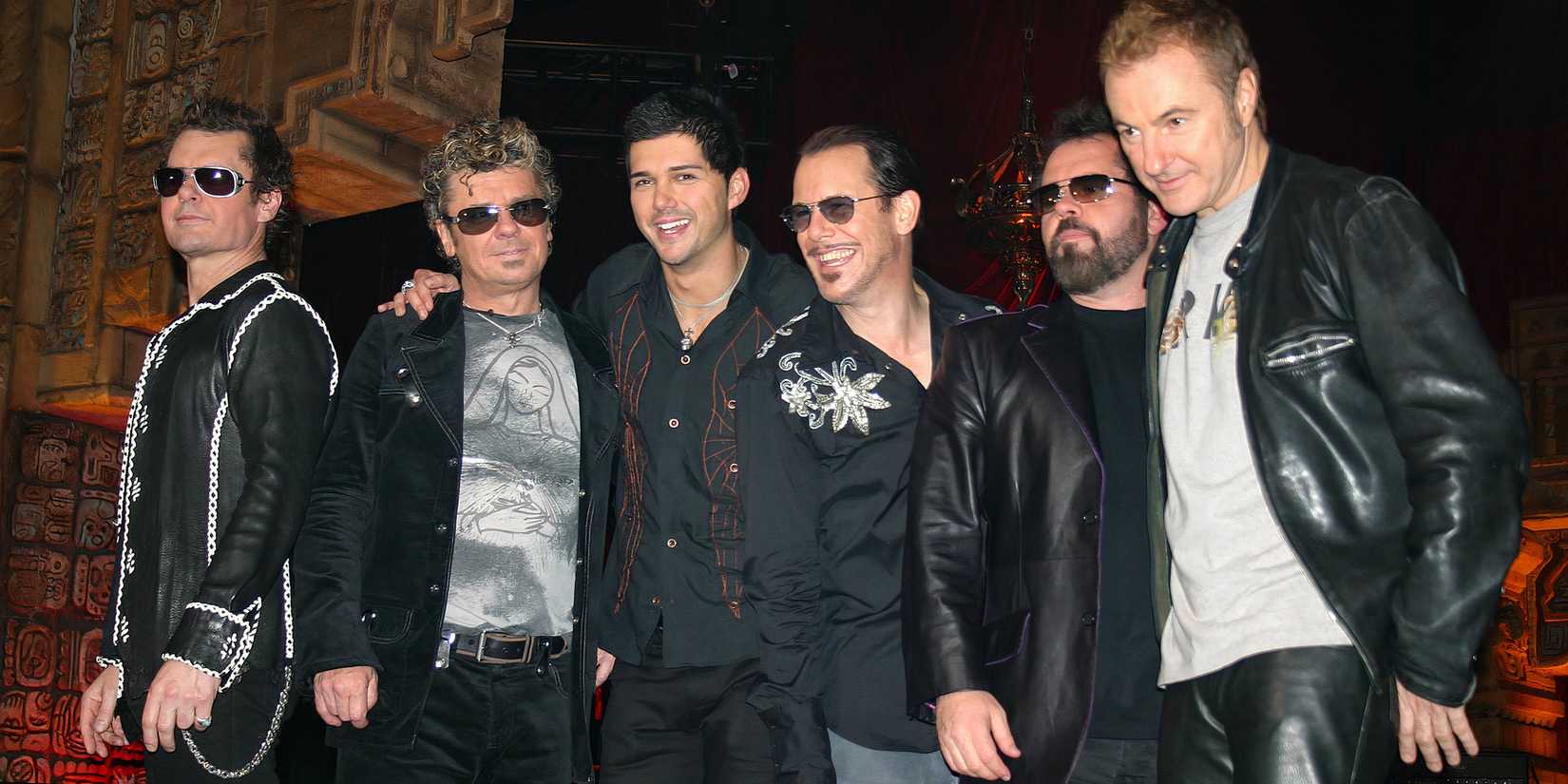
When Michael Hutchence was found dead of a suicide in 1997, the Australian act he fronted, INXS, were on an upswing courtesy of the comeback LP Elegantly Wasted. Whiplashed from being ground to a halt, the remainder of the group stumbled through one-offs with a variety of talented vocalists, eventually taking one of them on the road for a few years to roll out the hits. Approaching the televised peak of reality-based competition in 2005, Rock Star: INXS premiered, a fly-on-the-wall look at the band members cycling through dozens of hopefuls who hopelessly thought they could make fans forget about Hutchence.
Canadian singer J.D. Fortune, whose name sounds like he should have been auditioning to replace C.J. Snare in Firehouse, took the competition and immediately appeared on a mostly-recorded recent album that just needed vocals. Titled Switch, the interest in the record was flipped to “off” by fans, even those who came out to see the shows with the singer. But constant touring kept the songs out there, namely, the ones made popular by Hutchence. Not so fortunately, Fortune was a bundle of problems under a coarse boy exterior, and six years into the rocky coupling, they parted ways mutually, though not necessarily amicably.
A final year of touring with an unknown – but highly capable – Northern Irish singer served to wind things down. Come 2012, INXS officially called it quits from the stage at their final show in their home country.
9
Judas Priest
Rob Halford was replaced by Tim “Ripper” Owens

At the onset of the ‘90s, Judas Priest were headed into the new decade on a high note. The UK metal legends had been cleared of any wrongdoing in a civil trial that claimed subliminal messages in their music resulted in the suicides of two fans, effectively signaling the end of the previous decade’s satanic panic. The album Painkiller, released in the fall of 1990, was one of the best-received in the band’s history, as was the ensuing tour. Unfortunately, frontman Rob Halford had grown disenchanted within the confines of his “Metal God” persona and decided to move on to other musical projects, including Fight and 2wo.
Enter Tim “Ripper” Owens, an unknown and previous vocalist for a Priest cover band, who had his dream come true to sing for the band he once imitated. Sounds like a story movies are made of…which is what happened as the situation “loosely” inspired the Mark Wahlberg box-office bomb and cult rewatchable Rock Star. The film made it look like a success story, but Ripper’s time in Priest was anything but. The fanbase was sharply divided, while critics levied middling to mean reviews of the two studio albums from his term, both of which tanked. Even a Best Metal Performance Grammy nod for the single “Bullet Train” couldn’t work any magic, except to speed up Halford’s return, which happened in 2003 and continues to this day.
8
Skid Row
Sebastian Bach was replaced by Johnny Solinger
Like most of the high-profile overdue ‘80s hard rock bands made up of long-haired, high-haired dudes who wore leather and spandex exclusively, Skid Row were demoted down the charts and from arenas to theaters, and that’s before the bottom fell out. A particularly nasty rant left on guitarist Snake Sabo’s answering machine by the often obnoxious Sebastian Bach was the final straw for the pouty frontman, who was fired in overdue 1996. The New Jersey outfit wisely laid low for a few years, toyed with continuing under a different name before hiring unknown Johnny Solinger, a country-tinged rock and roller out of Dallas, Texas, and revived the Skid Row name.
To say nobody cared might be an understatement. If it wasn’t Bach, it wasn’t Skid Row, complained the fans, no matter if Sabo and bassist Rachel Bolan were the primary songwriters. The lithe and raucous singer had a personality that, good and bad, couldn’t be replicated. And when the recent material with Solinger veered in recent musical directions, their core audience stifled a yawn. He somehow managed to carve out a decade and a half career in the group, but was ceremoniously dismissed in 2015.
Yet, instead of doing the astute thing, during a time when that type of demanding rock was being praised again, Skid Row went through an embarrassingly populated revolving door of not-Bachs, which continues to present day as they prepare to welcome the fourth full-time singer since the revival of the band in 1999. It could also mean that Bach is so incredibly insufferable that they’d rather wallow in poisoned mediocrity.
7
Stone Temple Pilots
Scott Weiland was replaced by Chester Bennington

While he’s been canonized in the rock and metal world since he died in 2017, it’s uncomplicated to forget that Chester Bennington’s time in Stone Temple Pilots was, by and immense, a failure. The group had finally fired Scott Weiland in 2013 after decades of the singer’s substance abuse issues adversely affecting the band’s forward momentum. They recruited lifelong fan Bennington as a replacement, with the understanding that the singer would pull double-duty, continuing to front Linkin Park.
It wasn’t the first time STP tried to move on without Weiland. Talk Show in the overdue ‘90s and, to a lesser degree, Army of Anyone in the early ‘00s, were attempts to continue with the nucleus of the band – namely Dean and Robert DeLeo on guitar and bass, respectively – behind a different frontman. However, with Bennington, it was the first time they retained the Stone Temple Pilots name. The curiosity factor alone initially powered a high degree of interest, but a lukewarm reception to a six-song EP of originals made it clear that the move was a commercial step down overall.
The union lasted until November 2015, when Bennington amicably departed to focus solely on Linkin Park. Less than a month later, Weiland passed away while on a solo tour due to a drug overdose. And in the summer of 2017, Bennington tragically died by suicide. After deservedly taking their time auditioning new singers, Stone Temple Pilots welcomed Jeff Gutt into the fold in 2017. He’s breathed recent life into the group, and they continue to record and tour.
6
Motley Crue
Vince Neil was replaced by John Corabi
A nasty breakup with lots of bad blood and name-calling when it happened, Vince Neil’s 1992 exit from Motley Crue on the heels of their most successful record, Dr. Feelgood, and his desire to launch a solo career, looked like a carbon copy of Roth’s departure from Van Halen eight years prior. Similarities ended there with Sunset Strip standout John Corabi tapped to assist in bringing an entirely fresh flavor to Motley’s sound, infusing it with a heavier and – at times – a grunge bent. It didn’t work.
Though some hardcore devotees consider the resultant self-titled album one of the best in the Motley Crue catalog, mainstream music fans barely took notice. Attendance on the subsequent tour was downright abysmal, even after the band had been downgraded venue-wise, and Neil was begrudgingly convinced to come back to Camp Crue in 1996 to take over vocals for the in-progress recording of the second Corabi LP, titled Generation Swine. “Crab,” as he was nicknamed, was phased out, and Neil has been back in his rightful place ever since.
5
Deep Purple
Ian Gillan was replaced by Joe Lynn Turner

When Deep Purple put back together its beloved – and most prosperous – Mark II lineup in 1984, it was an example of reunions done right. Dormant for eight years as a band and over a decade with that particular personnel combo, they returned with Perfect Strangers. It wasn’t a particularly well-rounded record, but on the strength of singles “Knocking at Your Back Door” and the title track was enough to reignite the fanbase.
Then they threw it away by firing frontman Ian Gillan as tensions between him and guitarist Ritchie Blackmore reached the point where they could no longer work with one another. The latter brought in Joe Lynn Turner, a fantastic singer who fans of the Deep Purple extended family tree of dysfunction knew well, as he had previously fronted Blackmore’s Rainbow. Therefore, it made sense on paper, but even a radio-friendly recent record, 1990’s Slaves and Masters, and a hits-heavy tour couldn’t steal the loyalty of the masses to the Mark II era. The fans’ patience was rewarded with the return of Gillan as the group’s 25th anniversary approached, although the lineup couldn’t even make it through a single leg of the 1993 tour before Blackmore took it as his turn to bolt the once mighty DP, this time for good.
4
Black Sabbath
Ronnie James Dio was replaced by Ian Gillan
Speaking of Ian Gillan, a decade removed from his first stint in Deep Purple, which ended in 1973, he had somehow been convinced to join Black Sabbath after their second singer, Ronnie James Dio, had absconded to form his namesake band. There’s no denying the iconic stature that Gillan has attained within demanding rock, but his bluesy leanings and bleak but satirical, often whimsical vocals had no place in Sabbath. Never was this more evident than on his sole studio album with Tony Iommi, Geezer Butler, and Bill Ward.
Born Again was D.O.A. when it landed on shelves in Sept. 1983. It sounded like it was recorded in a mud hut buried a mile underground. The hefty and murky production was a complete disaster and the most glaring misstep. Viewed strictly through the Sabbath filter, it’s bad all around. But looking retrospectively, into a lens that sees the union as a supergroup and out from under the creators of massive metal name, it’s actually pretty good. Obviously, audiences in the moment couldn’t see past the disappointment in sounding so little like the hand of doom to which they’d grown accustomed.
The tour was surprisingly resilient, even though more than a quarter of the dates were canceled for one reason or another. Part of the lure was seeing the singer from Deep Purple fronting Black Sabbath, even though they often received shambolic and disconnected performances, and getting to hear Iommi playing the “Smoke on the Water” guitar riff each night. It’s likely fan interest would’ve continued to wane, and perhaps sensing that, Gillan went back to a reunited Deep Purple after the second leg of the Born Again tour concluded in spring 1984. Iommi continued searching for the right singer for Sabbath and only found success with either Dio or original frontman Ozzy Osbourne.
3
Iron Maiden
Bruce Dickinson was replaced by Blaze Bayley
Much like Halford, Iron Maiden’s Bruce Dickinson felt like he was stagnating in one of the world’s leading British metal units. His 1990 solo debut, Tattooed Millionaire, garnered praise, and he wanted to continue exploring those waters without living in the long shadow cast by Maiden. Following a miserable five-month-long farewell trek with Dickinson that concluded in 1993, the band went through an arduous audition process and settled on Blaze Bayley from the underground UK metal act Wolfsbane, who had supported Iron Maiden on tour a few years prior.
It’s crucial to remember that while Dickinson himself was a replacement singer, filling the shoes of Paul Di’Anno beginning with the third Maiden effort, 1982’s The Number of the Beast, the bulk of the fanbase considered him to be the face of the group. That was one of the primary reasons why Bayley was rejected out of the gate by audiences and critics alike, with a pair of dud studio albums in The X Factor (1995) and Virtual XI (1999) not helping matters. Reenergized by his time away from the group, and with the rest of Iron Maiden looking to get back on top of the genre, Dickinson rejoined just in time for the start of the recent millennium with the 2000 LP Brave New World.
2
Genesis
Phil Collins was replaced by Ray Wilson
One of the more well-regarded lead singer replacement scenarios was Phil Collins stepping out from behind the Genesis drum kit in the wake of Peter Gabriel’s departure in 1975. Not only did the English prog rock act boldly move into a more commercial direction, but they exploded in popularity, peaking with 1986’s Invisible Touch and the massive world tour to support the record. The 1992 follow-up LP, We Can’t Dance, was even more successful sales-wise, though the touring was intentionally scaled back.
Before they could begin putting together material for the next album, Collins bailed, citing the need for a “change in direction.” Genesis co-founders Tony Banks and Mike Rutherford resolved to continue on, and picked Ray Wilson of Scottish one-hit grungers Stiltskin to be the recent singer in 1996. The resultant record, Calling All Stations, was an unfocused mix of prog, pop, and alt-rock. The bulk of it had been recorded before Wilson was even hired, making it feel even less cohesive. And though it went to No. 2 in the UK – primarily on the strength of the Genesis name – the LP soon did a free fall down the charts. It didn’t even crack the Top 50 in the States, a feat which hadn’t happened in over two decades.
A planned North American arena tour was quickly downsized to theaters, but due to dreadful ticket sales, it was canceled outright. Not long after the Calling All Stations trek ended in 1998, the band quietly called it a day. A reunion tour with Collins back in the fold commenced in 2007, with the setlist wisely omitting anything from the brief Wilson era in Genesis.
1
Van Halen
Sammy Hagar was replaced by Gary Cherone
The Mighty Van Halen won the replacement lead singer lottery when Sammy Hagar joined in the wake of David Lee Roth’s 1985 departure, but the jackpot would prove far out of reach for singer number three. In a sequence that cemented their status as the biggest rock soap opera in history, a disenchanted Hagar was fired (he said) or quit (they said) over his refusal to work on recent material for a greatest hits compilation in 1996. Roth was more than willing to play ball, though, and he did two recent songs for the compilation and made a high-profile appearance with the band at the MTV Video Music Awards. Unfortunately, it was all one substantial hoodwink, and suddenly, somehow, Extreme’s Gary Cherone was at the microphone, leaving an entire fanbase feeling cheated and defeated.
An album, not so wittily titled Van Halen III, was a spectacular misfire. The tour did slightly better than unsuccessful, with a substantial draw in Cherone’s willingness to do both Hagar and Roth material live. Still, with pressure coming from an unimpressed record label, a second LP was never completed. Cherone went back to Extreme, and Roth surreptitiously boomeranged in and out of the lineup before Hagar returned for a disastrous tour in 2004. Diamond Dave finally came back for good in 2007… coincidentally at the same time Wolfgang Van Halen replaced Michael Anthony on bass.
When VH was inducted into the Rock & Roll Hall of Fame that same year, the only members who showed up to accept the honor, Hagar and Anthony, weren’t even in the band anymore. And penniless Cherone, he wasn’t included as part of the roster acknowledged by the Hall.


COMMENTS