
Benedict Cumberbatch is dreading stepping outside. He’s speaking to me from his air-conditioned hotel room in Soho at the peak of the summer heat. Fe
Benedict Cumberbatch is dreading stepping outside. He’s speaking to me from his air-conditioned hotel room in Soho at the peak of the summer heat. Few doubt that climate breakdown was a major cause of those scorchers, with nature, farming and water supplies all placed under huge strain. By midsummer, according to a report co-authored by the Met Office, there were 2,700 excess deaths in England and Wales due to the searing heat.
But for Cumberbatch, in a bittersweet way, the record-breaking temperatures have come at a good time. The actor has been on a tour to promote his fresh documentary, How to Live on Earth. “The irony is not lost on anyone,” he says. “We’re living in the results of climate breakdown so stepping outside is – literally – a call to action.”
double quotation mark‘I walk my dog on the heath. I cycle, use public transport – and I’m a wild-water nut’
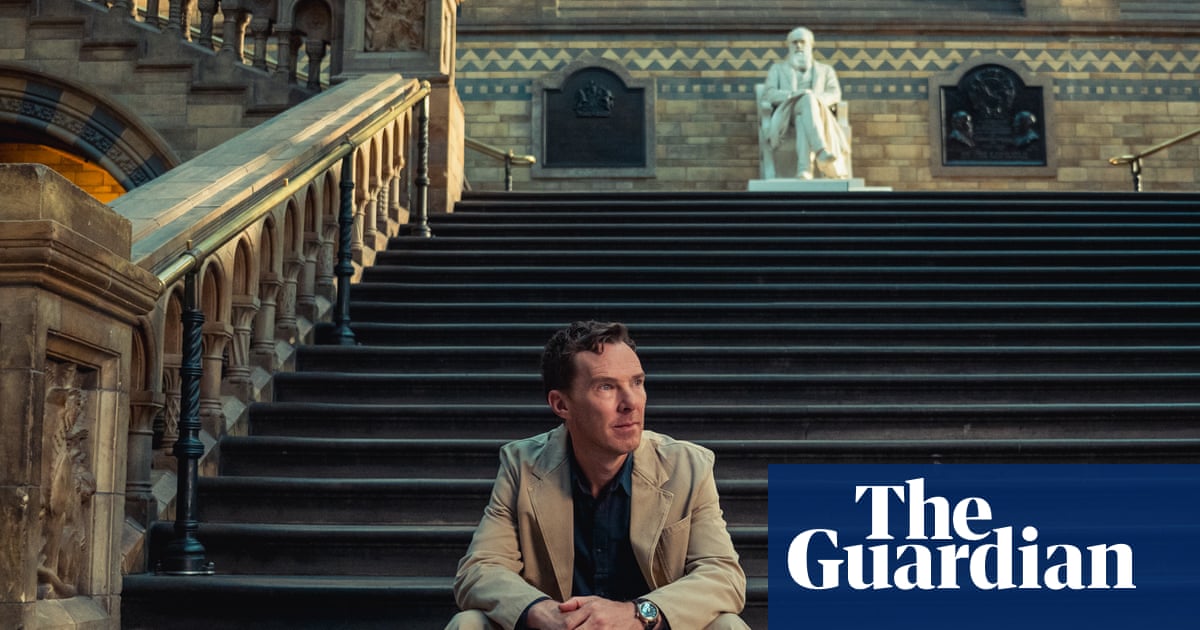
His film launches on YouTube this month and the actor hopes it is a “blueprint” for how we interact with our besieged planet in the future. It features Cumberbatch delivering monologues from the cavernous halls of the Natural History Museum in London, in between low films showing how activists, scientists and even chefs are learning a “new way to live on Earth” – one that could stop humanity damaging it.
Cumberbatch has spent the last two decades trying to reframe his relationship with the planet: he’s tried to live more gently on Earth and became vegan. However, this was a problem during the shooting of The Courier, in which he plays captured British spy Greville Wynne, who languishes in a Russian jail. “They said, ‘You can’t have any fibre in the last two weeks. You need to eat lean meat.’ And I was like, ‘I’m vegan!’”
‘You should think about eating a little bit of meat now’ … Cumberbatch in The Courier. Photograph: Liam Daniel/AP
No fibre for two weeks must have been tough on the bowels? “Yes, it was, but it was much less than what the character I was portraying went through, because it was a true story.” Although he went straight back on the vegetables, the extreme diet caused his blood sugar to plummet and he became unwell. “People were saying, ‘You should think about eating a little bit of meat now, because your body doesn’t really work under these conditions – you’ve lost so much weight.’”
Now, Cumberbatch tries to source the meat he does eat ethically, opting for venison, which in the UK needs to be culled as the country has an overpopulation of deer. But his experience on The Courier is just one way that working in films can challenge even the most committed eco-campaigner. Cumberbatch works with the Green Rider movement, which asks actors to make cutting pollution and emissions during filming a condition of taking part.
“What we’re trying to push towards is where it becomes contractual,” he says. “We’re working with Disney at the moment – their Avengers project in the UK. So yeah, it’s scaling up – and everyone I speak to about it in my community is on board.”
So, he’s ditched veganism, but would he get a private jet? “No,” he says, but adds the caveat: “We just waste our energy if we’re naysaying and calling people hypocrites. The fashion industry is a bigger polluter than aviation, and the food industry massively. That’s all of us, that’s everyone.” Not just movie stars.
‘A lot of the work we do just isn’t widely seen’ … snow leopard expert Dan O’Neill in the rainforest. Photograph: Open Planet Studios
The 50-year-old has long been an environmental campaigner. He visited the Extinction Rebellion protests in 2019 and has been dismayed by the recent government crackdowns on climate protests, with long sentences given to people who have blocked roads and smashed windows for the cause. “We should have the right in a democracy to peaceful action, even if it is direct action,” he says.
Cumberbatch is keen to highlight the film’s positive message and, unlike most environmental documentaries, it does (almost) have a joyful ending. It follows some remarkable people, from Indigenous activists trying to protect salmon from a dam, to Barack Obama’s former White House chef who is experimenting with alternative proteins. The message is that there are alternatives out there, and that nature can heal if humans stop hurting it.
One of the film’s most striking characters is Dan O’Neill, a biologist who studies large cats and spends weeks at a time in the depths of rainforests to study the creatures who live there. He’s hopelessly in love with nature and that comes across in the film. “I always work in remote places,” he says. “A lot of the work we do just isn’t seen by wide audiences. People in Mongolia often have never seen a snow leopard, for example. I am so proud How to Live on Earth is going on YouTube – as people who live in these remote places can see it. It democratises our message for the entire world. Indigenous communities will see themselves represented.”
In one scene, O’Neill is being whisked away from the rainforest in a car, and he turns on his phone to finally receive messages from friends and family after a long stretch without signal. But his dopamine hit turns to frustration as he is barraged with notifications and he ends up missing the seclusion of the forest. “That happens every time,” he laughs. “It is so weird that we are addicted to this little device. The ability to communicate with my family even from remote parts of the world is powerful. But the second you get your phone, you realise you don’t want it.”
Many of us have a similar love-hate relationship with our phones and Cumberbatch is no exception. “For about half a year,” he says, “I haven’t brought myself to look at the tally of unanswered WhatsApps and emails. It’s just thousands. I can’t deal with it.” He talks disparagingly of “swiping left, clickbait, all the rest of it”.
‘We’re making cutting emissions a condition of taking part in a film’ … in Avengers: Infinity War. Photograph: Chuck Zlotnick/AP
Jonnie Hughes, the film’s director, found O’Neill and all the other participants in far-flung corners of the globe. “Some people,” he says, “just cast themselves because they’re incredible individuals who have done something amazing and they can get across all the emotion and the excitement we should all be feeling, because it’s too easy to feel gloomy when we see what’s going on.”
Cumberbatch and company discuss some blue-sky thinking in the documentary, which to the jaded viewer could seem unrealistic. The conclusion is that the trees in rainforests should be viewed as more valuable than the gold underneath them – which may be true in some moral sense, but is it going to happen in today’s economic system?
double quotation markWe don’t want to foster extraction – nor all the other nasty things of populism and nationalism
“Nature that’s alive is actually far more valuable to us than dead nature,” Cumberbatch says. “So an elephant’s tusk is not worth as much as the elephant alive, in terms of what it brings to the savannah, to make the savannah work as an ecosystem. It’s how you create a new financial model whereby people can invest as shareholders in nature and that nature – which has done all this work for us for free – can actually be monetised to be protected, actually get paid.”
His view is refreshingly positive and he says he truly believes humans can save the planet: “Hopefully, what we’re seeing now in this last grab for the extractive industries is that we actually don’t want to foster that, nor all the other nasty things of populism and nationalism.”
Although the documentary takes us to remote places including the Amazon and Alaska, it also instructs the viewer to seek out nature at home and nurture it in cities. Where he lives, in Hampstead, London, Cumberbatch is in touch with nature almost daily, primarily through swimming in the ponds on the heath. “I am a bit of a wild-water nut,” he declares. “I also walk on the heath. I have a dog and I cycle and take public transport when I go into town.”
O’Neill is doing the same thing when he’s home, across town in Walthamstow. Although there aren’t any snow leopards, he’s managed to find nature: “We have Walthamstow wetlands, which are one of the most important in Europe. I have learned so much. I make sure I spend so much more time in nature in London now.”
Cumberbatch hopes to incorporate the message of the film into his daily life. “As a child, you have that sense of wonderment, which we do sadly lose. There’s a lot to knock it throughout our evolution as humans. So hold on to that – and realise how precious it all is.”
How to Live on Earth is on YouTube from 20 September

