
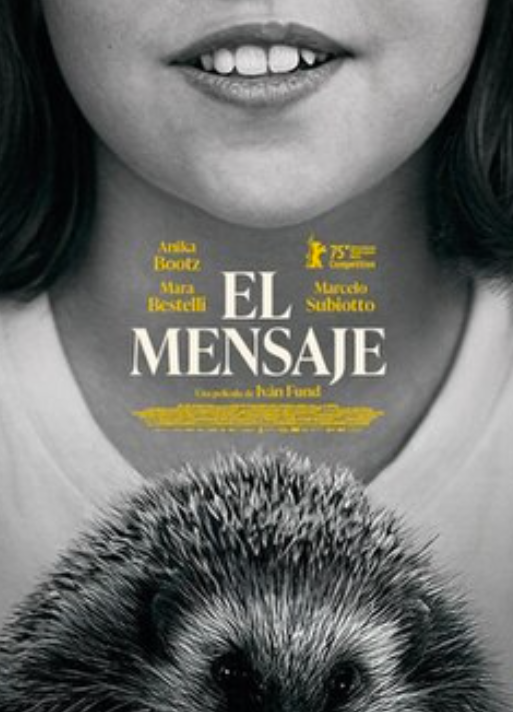
At the Berlin International Film Festival 75th edition, amid louder political allegories and high-concept cinema, Iván Fund presented one of the compe
At the Berlin International Film Festival 75th edition, amid louder political allegories and high-concept cinema, Iván Fund presented one of the competition’s most discreet yet haunting works. The Message is a low-key, black-and-white road movie that resists explanation, favoring atmosphere over answers and intimacy over plot — a film that drifts gently between realism and belief, between survival and grace.
Shot in luminous monochrome, The Message follows young Anika, played with disarming naturalness by Anika Bootz, as she travels through rural Argentina in a modest camper van with her guardians, Myriam and Roger (Mara Bestelli and Marcelo Subiotto). The trio moves from village to village offering an unusual service: Anika claims to communicate with animals — living or dead — relaying their thoughts, emotions, and final wishes to anxious owners in exchange for a small fee.
Whether this “gift” is genuine, imagined, or gently manufactured is a question Fund pointedly refuses to resolve. Instead, The Message exists in a space of productive ambiguity. It is less concerned with exposing deception than with observing why people choose to believe — and how belief, even when fragile or fictional, can become a form of care. In a country weighed down by economic instability, where inflation erodes certainty and tomorrow feels perpetually deferred, hope itself becomes a modest currency.
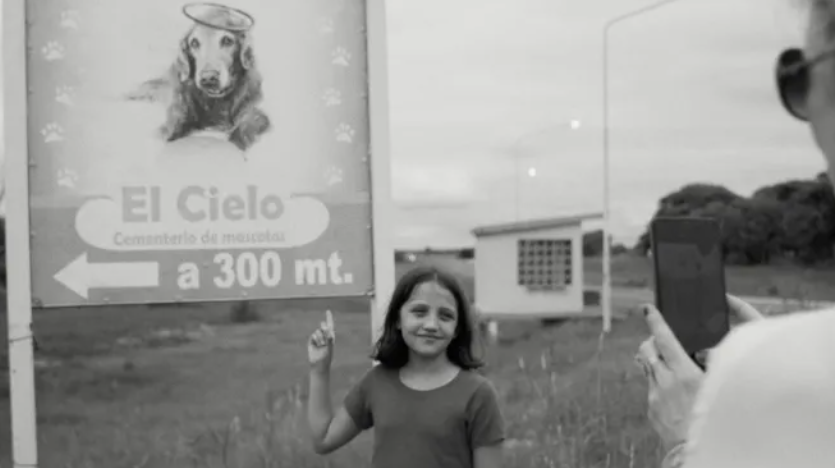
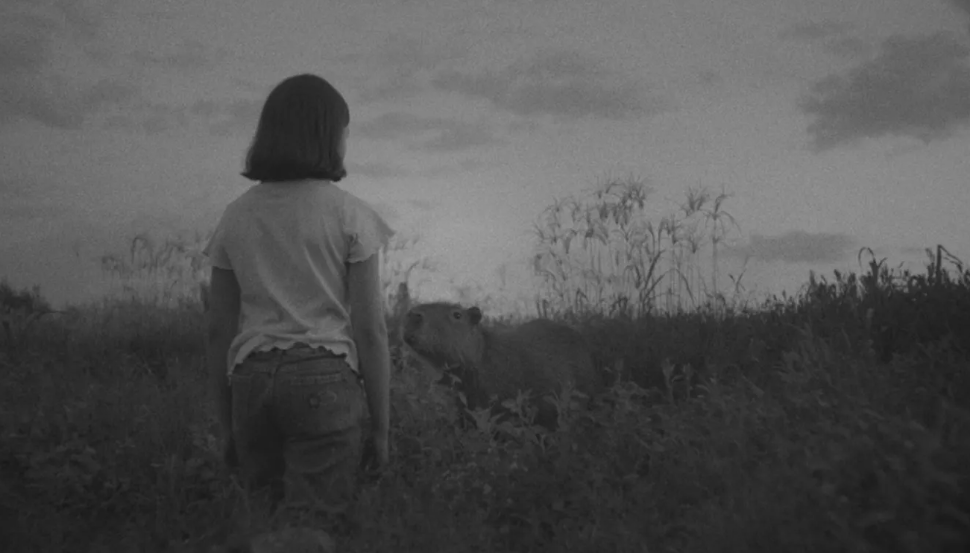
Fund’s direction is rigorously restrained. Working with cinematographer Gustavo Schiaffino, he crafts images that recall early Jim Jarmusch and Wim Wenders — long takes, static frames, figures dwarfed by landscapes. The Argentine countryside appears both expansive and empty, a place where time stretches and meaning must be invented moment by moment. Animals wander freely through abandoned towns; horses cross streets without urgency; a capybara emerges from the brush in a moment of pure, unforced wonder.
Narratively, The Message unfolds like a collection of encounters rather than a plotted journey. Clients arrive with turtles, cats, dogs, memories, grief. Messages are delivered via whispered interpretations or voice notes. Myriam manages the performance with careful tenderness; Roger handles logistics and online payments. Their roles seem practical, even loving, yet the film quietly invites suspicion. Are they exploiting Anika? Or protecting her? Or simply improvising survival in a world that offers few alternatives?
A crucial shift occurs when Anika is taken to visit her mother, a patient in a remote psychiatric institution, portrayed with aching restraint by Betania Cappato. This brief, nearly wordless scene reframes everything that came before. What initially looked like manipulation reveals itself as a fragile, improvised family structure — one built on affection, necessity, and mutual dependence. The “con” dissolves into something more human: a shared fantasy that allows all three to keep moving.
Fund, who also edits the film, maintains a deliberately light narrative footprint. Exposition is withheld. Backstories remain hinted at, never spelled out. Even the supernatural is treated with indifference rather than spectacle. If Anika truly hears animals, the film suggests, it matters less than the fact that she listens — and that others listen to her. Communication, not revelation, is the film’s true subject.
Composer Mauro Mourelos underscores this mood with sparse, almost fragile musical cues — lonely horns, drifting notes that echo across open spaces. Sound design and silence work together, reinforcing the sense that this is a world attuned to small gestures rather than dramatic turns.
Ultimately, The Message is not about whether miracles exist, but about how meaning is constructed in the absence of certainty. It is a film that trusts the viewer’s patience, inviting us to observe rather than judge, to feel rather than decode. In its final moments — tender, unresolved, quietly affirmative — Fund leaves us with a simple proposition: that kindness, imagination, and belief may be indistinguishable, and that sometimes the medium truly matters more than the message.
Unassuming, beautifully shot, and emotionally precise, The Message emerged at Berlinale 2025 as a reminder that cinema does not always need to raise its voice to leave a lasting echo.
By Nabil Jasim Alani – Theworldscreen – berlinale75


COMMENTS