
Venice 2025 | TheWorldScreen Review By Sari Albeder | TheWorldScreen VENICE, Italy — Some novels transcend literature to become cultural landmarks.
Venice 2025 | TheWorldScreen Review
By Sari Albeder | TheWorldScreen
VENICE, Italy — Some novels transcend literature to become cultural landmarks. Albert Camus’ The Stranger (L’Étranger), first published in 1942, belongs to that rare category. More than eighty years after its release, it continues to challenge readers with its exploration of alienation, morality, and the absurdity of existence. Adapting such an influential work has always carried enormous expectations, but François Ozon approaches the material with confidence, restraint, and unmistakable visual elegance.
Premiering in Competition at the 82nd Venice International Film Festival, Ozon’s The Stranger is not simply another literary adaptation. It is an atmospheric, meticulously crafted meditation on one of modern literature’s most enigmatic protagonists, preserving the philosophical spirit of Camus while finding its own cinematic identity.
Returning to One of Literature’s Most Complex Characters
At the center of the story is Meursault, portrayed with remarkable restraint by Benjamin Voisin. An ordinary office worker living in French colonial Algeria during the early 1940s, Meursault experiences life with an emotional detachment that continually confounds those around him.
His apparent indifference begins with the death of his mother, where his lack of outward grief immediately places him at odds with society’s expectations. What initially appears to be emotional distance gradually becomes something much larger as a seemingly ordinary sequence of events leads to a fatal encounter on a sun-soaked beach.
Rather than constructing a traditional courtroom thriller or psychological drama, Ozon remains faithful to the novel’s central idea: society ultimately judges Meursault less for what he has done than for who he appears to be.
François Ozon Finds Beauty in Restraint
Known for his remarkable versatility, François Ozon has spent decades moving effortlessly between melodrama, psychological thrillers, family dramas, and literary adaptations.
With The Stranger, however, he embraces perhaps his most disciplined filmmaking style.
The film rarely raises its voice. Dialogue is economical. Silence carries enormous dramatic weight. Every scene unfolds with quiet precision, allowing viewers to absorb emotion through gesture, atmosphere, and composition rather than exposition.
Instead of modernizing Camus’ work or attempting to impose contemporary interpretations upon it, Ozon demonstrates confidence in the timeless strength of the original material.
That confidence becomes one of the film’s greatest assets.
Benjamin Voisin Anchors the Film
Much of the adaptation’s success depends on Benjamin Voisin’s portrayal of Meursault.
The performance avoids theatrical displays of emotion and instead embraces stillness, uncertainty, and emotional ambiguity. Voisin never asks audiences to sympathize with his character, nor does he push them toward condemnation.
Instead, he presents Meursault as someone profoundly disconnected from conventional expectations, allowing viewers to decide for themselves whether his honesty represents courage, emotional emptiness, or something far more complicated.
It is a demanding role that requires precision rather than spectacle, and Voisin delivers one of the most mature performances of his career.
A Strong Supporting Ensemble
Rebecca Marder brings warmth and vulnerability to Marie Cardona, whose affection for Meursault repeatedly collides with his inability—or unwillingness—to reciprocate emotional certainty.
Pierre Lottin delivers an energetic performance as Raymond, whose volatile behavior becomes the catalyst for the tragedy that follows. His presence injects tension into the narrative while exposing the casual violence that surrounds everyday colonial life.
Elsewhere, Denis Lavant, Swann Arlaud, Hajar Bouzaouit, Christophe Malavoy, and the broader ensemble contribute nuanced performances that enrich Ozon’s restrained storytelling.
No character feels exaggerated.
Everyone exists within the same carefully controlled emotional universe.
Colonial Algeria Reconsidered
One of Ozon’s most significant contributions lies in how he approaches the colonial setting.
While remaining respectful of Camus’ original text, the director subtly expands the world surrounding Meursault. Streets, neighborhoods, public spaces, and relationships quietly acknowledge the political and social inequalities of French Algeria without allowing historical commentary to overwhelm the narrative.
Characters who occupy only limited space in the novel receive greater presence here, creating a richer sense of place while preserving Camus’ existential focus.
Rather than rewriting history, Ozon encourages audiences to observe the world beyond Meursault’s limited perspective.
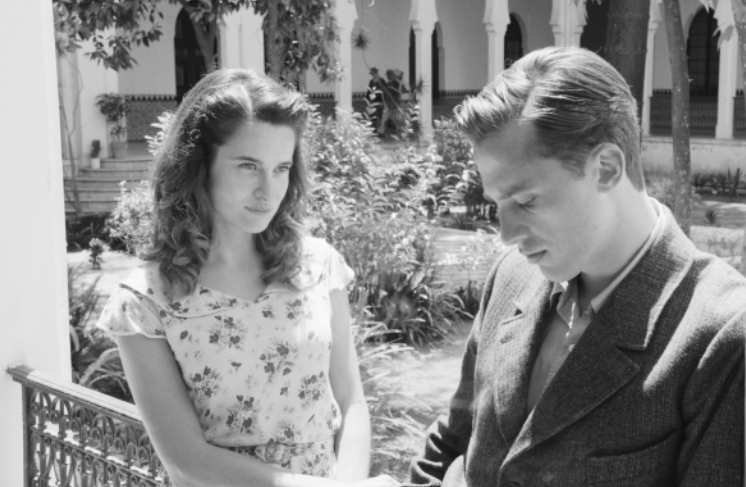
Black-and-White as Emotional Language
Visually, The Stranger ranks among the most striking films presented in Venice this year.
Cinematographer Manu Dacosse embraces high-contrast black-and-white photography that transforms every frame into carefully composed visual poetry.
The choice feels entirely appropriate.
Without color, attention shifts toward texture, architecture, light, shadow, and facial expression. Harsh Mediterranean sunlight becomes almost tangible, while interiors acquire a timeless elegance that recalls classic European cinema without becoming nostalgic.
Morocco convincingly doubles for colonial Algeria, offering expansive landscapes that reinforce both physical beauty and emotional isolation.
Every location contributes to the film’s philosophical atmosphere.

The Stranger – Venice Film Festival
Music That Respects Silence
Composer Fatima Al Qadiri provides one of the year’s most understated scores.
Rather than overwhelming scenes with orchestral emotion, her music blends subtle electronic textures with Arabic influences, complementing the film’s meditative rhythm.
Equally important is Ozon’s willingness to allow silence to dominate many sequences.
The absence of music often speaks louder than melody itself, reinforcing Meursault’s emotional distance while allowing audiences to experience events with remarkable intimacy.
Themes That Continue to Resonate
What makes The Stranger endure after more than eight decades is its refusal to offer comfortable answers.
The film explores questions that remain deeply relevant today:
- How should society judge those who refuse to conform?
- Does honesty always lead to justice?
- Can morality exist independently of social expectations?
- What meaning can individuals create within an indifferent universe?
Ozon never simplifies these questions.
Instead, he allows them to emerge naturally through the story’s progression, trusting viewers to wrestle with them long after the credits roll.
Venice Reception
The Venice premiere generated significant discussion among critics and festival audiences.
While some praised Ozon’s unwavering fidelity to Camus and the film’s extraordinary visual craftsmanship, others debated its deliberate pacing and emotional restraint.
Such divided responses seem almost inevitable for a work rooted in existential philosophy.
Regardless of differing opinions, few questioned the ambition behind the project or the remarkable technical accomplishment visible throughout.
Among the Competition titles, The Stranger immediately established itself as one of the festival’s most intellectually engaging films.
Literary Adaptation Without Compromise
Many classic novels lose their philosophical depth when translated to the screen.
Ozon largely avoids that trap.
Rather than reducing Camus’ work to plot alone, he captures its emotional rhythm and intellectual uncertainty. The adaptation neither idolizes the novel nor attempts to replace it.
Instead, it exists alongside the original as a thoughtful cinematic interpretation.
Readers familiar with Camus will recognize the essential spirit of the text, while newcomers may find themselves inspired to discover one of the defining works of twentieth-century literature.
TheWorldScreen
François Ozon’s The Stranger is not designed for viewers seeking conventional dramatic satisfaction.
It demands patience, reflection, and emotional openness.
Those willing to embrace its quiet rhythm will discover one of the most elegant literary adaptations in recent years—a film that respects Albert Camus’ philosophical legacy while confidently establishing its own cinematic voice.
With exceptional black-and-white cinematography, restrained yet compelling performances, and a thoughtful exploration of morality, justice, and human isolation, The Stranger confirms François Ozon’s continuing ability to reinvent himself while remaining faithful to the emotional complexity of his subjects.
It is less concerned with providing answers than with inviting audiences into one of literature’s most enduring conversations.
TheWorldScreen Rating
★★★★☆ (4.5/5)
Film Information
Title: The Stranger (L’Étranger)
Director: François Ozon
Screenplay: François Ozon & Philippe Piazzo, based on the novel by Albert Camus
Cast: Benjamin Voisin, Rebecca Marder, Pierre Lottin, Denis Lavant, Swann Arlaud, Christophe Malavoy, Hajar Bouzaouit
Cinematography: Manu Dacosse
Music: Fatima Al Qadiri
Running Time: 123 minutes
Language: French, Arabic
Section: Official Competition – Venice International Film Festival 2025
Production: Foz, Gaumont, France 2 Cinéma
World Sales: Gaumont

